On this page
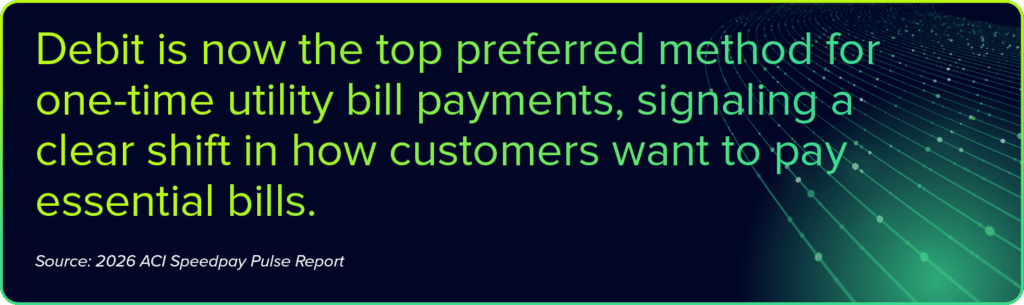
Debit is becoming one of the clearest signals of what utility customers want from the payment experience: more control, more visibility, and less friction. For utilities, the rise of debit should not be treated as a payment preference alone. It is a signal that customers want payment experiences designed around control, confidence, and fewer points of friction. The 2026 ACI Speedpay Pulse Utility Payment Trends Report found that debit cards remain consumers’ preferred method for one-time bill payments, chosen by 37.6% of consumers in 2025, ahead of checking account deduction at 26.4% and credit cards at 25.4%.
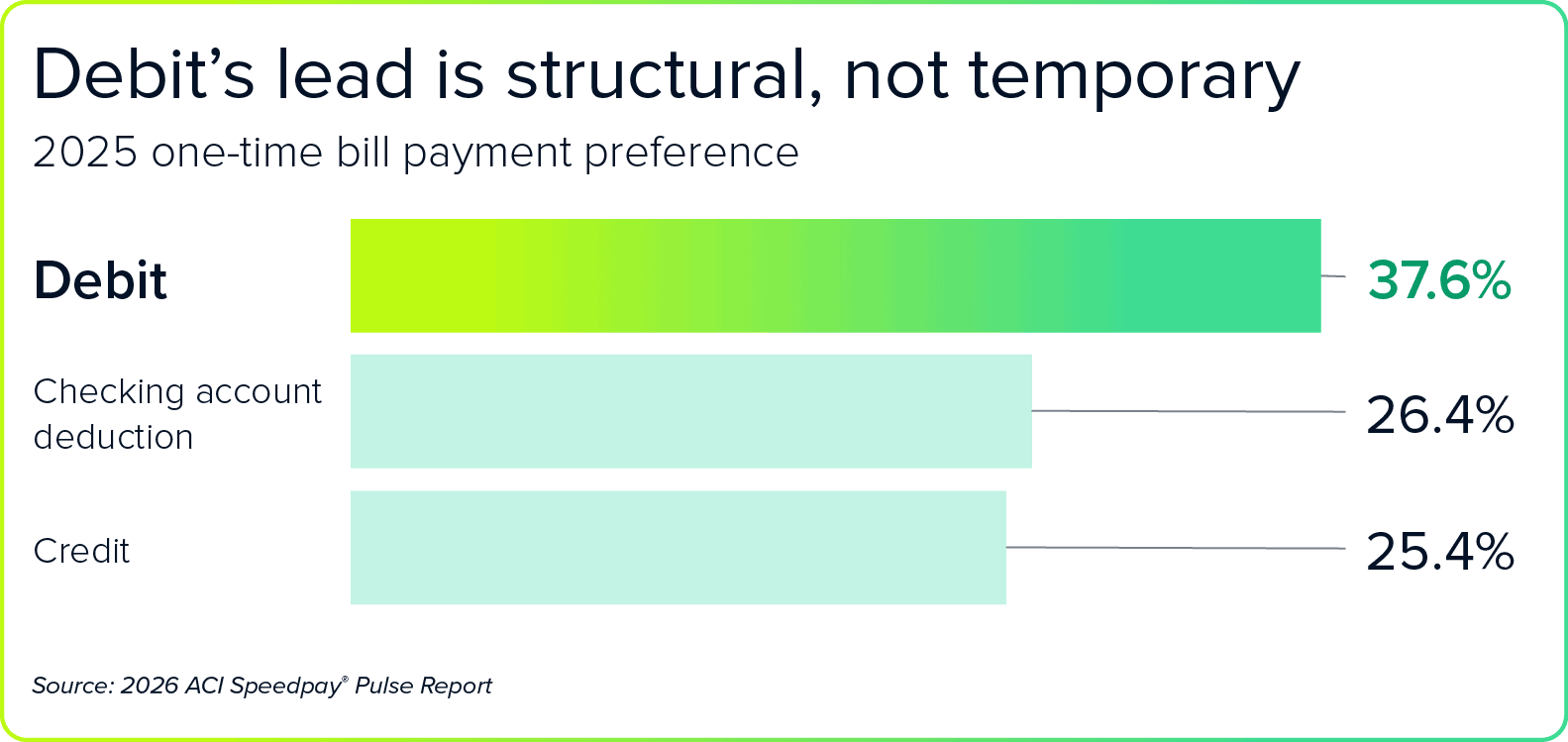
Debit’s lead is not a passing trend. It already led credit by more than 11 percentage points back in 2018, and today’s 11.4-point gap is nearly identical, confirming that debit’s advantage is a structural feature of how consumers want to pay, not a temporary shift. For utilities, that is more than a payment mix statistic. It is a customer experience signal and a business signal. The opportunity is no longer just to offer debit, but to make it easier to choose, manage, and trust across payment journeys.
That distinction matters because utility bill payment is recurring, essential, and often shaped by tight household cash flow. Bills for utilities alone made up 21.7% of the monthly payments consumers reported submitting over the past year, on par with telco, cable, consumer finance, and insurance. The Pulse Report also found that two in three Americans live paycheck to paycheck, and nearly half of Gen Z and Millennial consumers, along with 40% of Gen X consumers, do not have enough in their bank account to cover a $1,000 emergency expense.
At the same time, according to Fueling Debt: How Rising Utility Costs Are Overwhelming American Families, monthly energy costs rose from $196 to $265 between 2022 and 2025, while average overdue utility balances climbed from $597 to $789. Nearly 14 million Americans now have utility debt severe enough to be in or near collections. J.D. Power’s 2025 Electric Utility Study reinforces the pressure: overall residential satisfaction dropped to 499 out of 1,000, the lowest score recorded across all J.D. Power utility studies, with billing and payment satisfaction falling 11 points year over year as average monthly bills reached $206 in the fourth quarter of 2025. In that environment, payment choice becomes part of affordability management, and customers are gravitating toward options that help them stay closer to available funds and better control when money leaves the account.
For utilities, the implication is practical. When customers can use their preferred payment method inside intuitive self-service journeys, utilities can improve digital adoption, encourage on-time payments, and reduce the manual effort associated with exceptions, late follow-up, and payment friction.
Debit is not a silver bullet, but when it is fully integrated into web, mobile, guest pay, and autopay journeys, it can help utilities align payment experience with customer behavior while supporting operational efficiency behind the scenes.
Why debit keeps winning
Utility payments are necessary, not optional, and they compete with rent, groceries, insurance, and transportation inside the same household budget. That makes payment choice highly practical. The Pulse Report points to three reasons debit fits this moment. First, direct bank account linkage gives consumers real-time visibility into their available balance, without the lag of a credit card billing cycle. Second, debit transactions are immediate, giving instant confirmation that a payment has gone through. Third, and perhaps most important during a period of financial strain, debit imposes natural spending discipline: consumers can only spend what they have. For the 48% of Gen Z and 46% of Millennial consumers with less than $1,000 in emergency savings, that built-in guardrail is not just a convenience; it is a financial necessity.
The generational data underscores how deeply this preference has taken hold. Debit usage among Gen Z now stands at 74.7%, and at 64.6% among Millennials, making it the most-used payment method for both generations by a wide margin. Gen X debit usage has climbed to 49.7%, just behind checking account deduction. Only among Boomers does debit fall to third place, at 31.0%, and even their usage reached a study high in 2025. As younger consumers age into higher bill volumes, debit’s overall share is positioned to keep growing, and utilities will need digital payment experiences that reflect how these customers already prefer to pay.
Debit is gaining strength inside digital payment journeys
The rise of debit is being reinforced by the broader shift to digital payments. Utility biller websites account for 39.4% of preferred payment channels and biller mobile apps for 19.1%, up from just 7.9% in 2019. The J.D. Power 2026 U.S. Utility Digital Experience Study found that mobile apps generate the highest customer satisfaction scores, yet 28% of utilities still do not offer one. Mobile wallets are moving into the mainstream as well: 40% of consumers reported paying a bill via mobile wallet in 2025, up sharply from just 17% in 2019, with adoption highest among Gen Z (66%) and Millennials (54%). Even so, paper habits are slow to change, separate research commissioned by Doxim and Keypoint found that 63% of utility customers still receive a paper bill, even when a digital option exists. Utilities that make debit prominent inside intuitive web, mobile, and mobile wallet journeys will be better positioned to reduce friction, improve satisfaction, and align with how customers already prefer to pay.
The next opportunity is debit-enabled autopay with customer control
Debit should not be viewed only as a one-time payment preference. As more customers become comfortable using debit in web, mobile, and wallet-based journeys, utilities have an opportunity to extend that preference into recurring payment models that still preserve customer control. A more flexible approach to autopay can combine convenience with visibility, reminders, and the ability to manage timing before a payment is made. The share of consumers who use a mix of one-time and recurring payments has grown steadily, from 43.4% in 2019 to 55.4% in 2025, while relying only on one-time payments has fallen from 43.4% to 30.3% over the same period. Debit is a natural fit for that shift: unlike credit, debit-based autopay draws directly from available funds and settles immediately, so there is no revolving balance to manage separately.
According to Chartwell’s utility payments research, autopay and mobile payments are critical initiatives for utilities seeking to improve revenue stability and reduce delinquencies. Consumers are telling billers exactly what would make that convergence work: 57.7% say they would use flexible due dates, 44% want real-time reminders, and 30.4% want the ability to pause payments during hardship. The opportunity is to make debit-based autopay easy to enroll in, easy to update, and supported by the reminders and confirmations that help customers stay in control.
What debit versus ACH actually costs
Consumer preference is one side of the debit story. The other is what happens on the back end when a payment fails, and that side of the ledger often gets overlooked. In a recent ACI Speedpay blog, Why lenders should treat debit as a strategic payments rail, David Williams, Director of Consumer Finance Sales at ACI Speedpay, laid out the true cost of ACH failures using Visa data shared with ACI in 2025: processing an ACH return costs roughly $6 in labor, compared with just $0.10 for a debit decline. Live agent handling time tells a similar story, running about eight minutes for an ACH return versus four minutes for a debit decline. Williams was writing for consumer lenders managing loan payments, but the underlying mechanics apply just as directly to utility billing. A returned ACH payment still means a delayed failure notice, a manual reprocessing step, a customer service call, and a collections workflow, all before the utility even knows the payment did not go through.
Debit works differently because authorization happens in real time. There is no multi-day wait for a return notice and less back-end reconciliation work. That timing difference matters for utilities in the same way it matters for lenders: Visa data cited in Williams’ analysis found that real-time debit authorization can contribute to up to a 20% reduction in delinquencies compared with ACH, by preventing the kind of payment gap that lets a past-due account roll from 30 days to 60. For a utility collections team, that is fewer accounts drifting into deeper delinquency and fewer manual touches per exception.
None of this means ACH is the wrong choice, or that debit is free. Debit carries interchange, and network discount programs from Visa and Mastercard can help narrow that cost gap for recurring bill payments. But ACH’s advantage on sticker price often hides the full cost of returns, delayed failures, manual reprocessing, and the customer service load that comes with it all. A useful complement to Williams’ analysis is NACHA’s ACH Network Risk and Enforcement Rules, which cap the unauthorized return rate at 0.5% and the administrative return rate at 3%. Utilities that rely heavily on ACH need to actively monitor those thresholds, since exceeding them can trigger a formal inquiry, require corrective action, and, in persistent cases, restrict ACH origination privileges through the sponsoring bank. That is a compliance cost that a per-transaction fee comparison will not capture, and it is one more reason to weigh the full cost of each rail rather than the sticker price alone.
For a utility finance or operations executive, the practical takeaway is to model the full cost of each payment rail, not just the per-transaction fee. Include the labor cost of exceptions, the customer service load created by delays, the reconciliation effort, and the collections impact of accounts that drift further past due while a return notice is still in transit. When utilities account for all of that, debit’s advantage often extends well beyond the interchange line.
Modernization is the foundation debit needs to scale
Billers are already leaning into debit as a strategic priority. According to the 2026 ACI Speedpay Biller Impact Study, 90% of billers plan to add or expand debit over the next 12 to 24 months, making it the top-planned payment method investment. Sixty-six percent of billers already rate debit as very important to their bill pay strategy, and 64% say they are very likely to increase investment in the near term. That momentum is not optional. A May 2026 survey of 714 billers found that only 18% are very confident their legacy bill pay platform will support future business objectives, and as a result, 76% plan to evaluate new bill pay options within the next 12 to 24 months. Payment resiliency, the ability to ensure every transaction goes through cleanly and on time, is the number one motivator behind that shift. For utilities, this is the moment to pair growing debit adoption with the modernized, resilient payment infrastructure needed to support it at scale, and to reduce the manual work tied to exceptions and follow-up.
What utilities should do next:
Make debit more visible across payment channels
Debit should be easy to find and easy to choose across web, mobile, guest pay, and autopay enrollment, especially given how far ahead it is with Gen Z and Millennial customers.
Pair debit with stronger digital experiences
As mobile apps and mobile wallets continue to grow, utilities should reduce friction in the payment journeys customers already prefer, particularly mobile, where satisfaction runs highest, but availability still lags.
Design autopay around customer control
Flexible due dates, real-time reminders, and simple self-service updates can make recurring debit payments easier to trust and manage, helping customers avoid missed payments during periods of financial stress.
Modernize for resilience and scale
Reliable, secure payment infrastructure is essential for supporting satisfaction, collections, and long-term digital growth, particularly with most billers planning to re-evaluate their systems in the next two years.
Model the full cost of each payment rail
Compare debit and ACH beyond the per-transaction fee. Factor in return handling, customer service load, reconciliation effort, and delinquency impact, and look at network discount programs to help manage debit interchange on recurring bill payments.
Utilities that make debit easier to find, enroll in, and manage across the customer experience will be better positioned to improve satisfaction, strengthen collections, and lower friction across the payment lifecycle. The competitive advantage will come not from offering debit alone, but from operationalizing it as a seamless part of the customer experience. For utilities evaluating how debit fits into a broader payment modernization strategy, the next step is to look beyond payment acceptance alone and assess how each journey supports control, resiliency, self-service, and operational efficiency. ACI Speedpay helps utility billers deliver those experiences through resilient payment infrastructure, secure digital journeys, and operational intelligence designed to support payments at scale.
Related content

Never miss a payment
The next era of bill pay: Meeting customers where they are—and where they are going.
ACI Speedpay Biller Impact Study: A new era in bill pay has arrived
Discover the strategies and innovations shaping the next era of bill payment
The case for lenders to accept debit card payments
There is a strong, growing consumer preference for using debit cards with bill payments, especially among younger generations

Why modern bill pay requires more than the lowest-cost rail
Billers across industries, from mortgage servicing to credit cards, utilities, and insurance, are actively modernizing their bill pay infrastructure.

The modern debit card: The engine behind seamless payments
Cards continue to play a central role in bill pay and recurring payments, giving customers a familiar, trusted way to complete transactions across channels.

Sean McAnally is a business development and utility industry professional with more than 15 years of experience partnering with utility and government organizations. He specializes in helping organizations improve customer engagement, increase self-service adoption, and streamline operations through scalable payment, billing, and customer communication solutions. By leveraging innovative technologies and best practices across multiple customer touchpoints, Sean helps clients reduce costs, improve operational efficiency, and enhance customer satisfaction while achieving their strategic goals and objectives.