On this page
A few years ago, I sat in a servicing center with a team trying to understand why some auto-loan borrowers kept drifting from 30 days past due to 60. The borrowers were not disappearing. Their ACH payments had failed, return notices surfaced days later, and by the time anyone followed up, the next due date was already approaching. That gap is where avoidable servicing work, borrower frustration, and deeper delinquency begin.
That moment is why debit deserves a bigger role in consumer finance. Borrowers are making their preference clear: they want payment methods that feel immediate, visible, and easy to manage. Lenders that continue to default to ACH risk adding friction at the exact moment borrowers need certainty.
The numbers don’t leave much room for debate
According to the 2026 ACI Speedpay Pulse Report, 52.7% of consumers now use a debit card to pay bills, up from 42.1% in 2020 and a study high. Debit now leads credit cards (41.3%) by 11.4 percentage points, a margin nearly identical to the gap first recorded in 2018, confirming debit’s rise is a structural feature of how consumers pay, not a passing trend. New 2026 YouGov research commissioned by ACI Worldwide reinforces the shift: 53.7% of US adults now use debit to pay bills, more than any other payment method.
The signal is especially relevant for consumer finance. The same YouGov research found that 16.1% of consumers already use debit for loan payments, including auto, student, mortgage, personal loans, and Buy Now Pay Later, with that figure climbing to 20.4% among Millennials. This is not a niche behavior. It is a broad shift in how borrowers manage money.
The real problem: Billers stuck between two bad options
Many consumer finance billers are caught in an uncomfortable middle ground. They are either bolting debit onto legacy platforms or working with providers that treat bill pay like retail commerce and miss the operational complexity of loan payments. The result is limited flexibility, avoidable servicing work, and payment experiences that do not match how borrowers increasingly want to pay.
According to the 2026 ACI Speedpay Biller Impact Study, based on a May 2026 survey of 714 billers, only 18% are “very confident” their legacy bill pay platform will support future business objectives. That confidence gap helps explain why 76% plan to evaluate new bill pay options within the next 12 to 24 months. Tellingly, when billers do plan to invest, debit is where they are putting their money: 90% plan to add or expand debit over the next 12 to 24 months, the single largest planned payment method investment, and 66% already rate debit as “very important” to their bill pay strategy.
Processing an ACH return costs $6 in labor. A debit decline costs just $0.10.
Why debit outperforms ACH where it matters most for lenders
ACH is familiar, and its per-transaction cost can look attractive on paper. But that headline number often obscures the true cost of ACH-based collections: returns, delayed failures, manual reprocessing, borrower follow-up, and compliance workflows.
Borrowers do not see ACH as easier, either. In 2026 YouGov research, 37.2% said debit is the easiest payment method to set up for bills the first time, nearly double the 19% who chose ACH. That setup gap matters because enrollment friction is where failed payments and service costs can begin.
Guaranteed funds and real-time validation
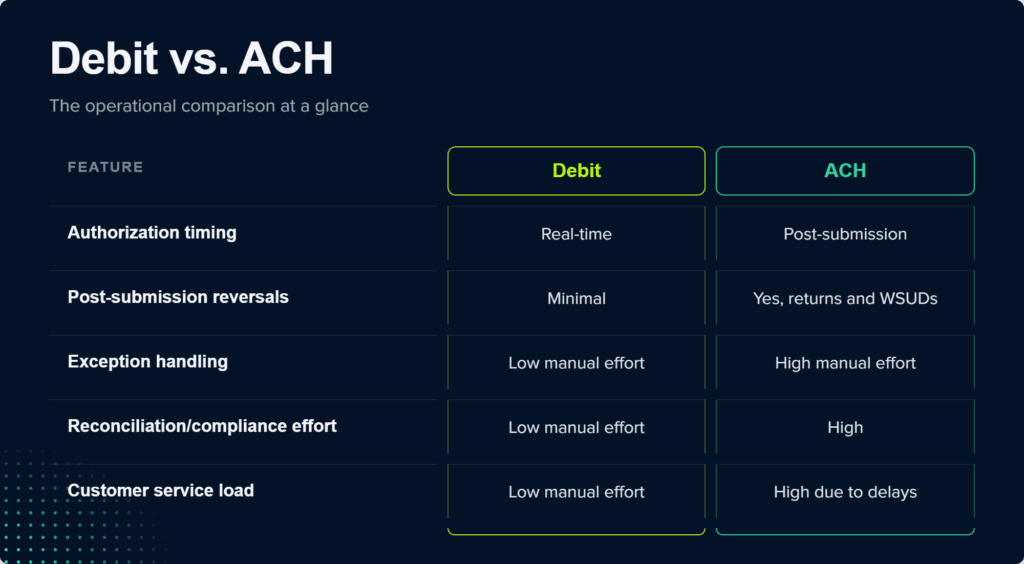
With debit, authorization happens in real time. There is no waiting for a return notice days later and fewer reconciliation headaches. That matters in consumer finance, where payment timing affects interest calculations, late-fee logic, and regulatory reporting.
Visa data shared with ACI in 2025 shows a stark difference when payments fail: the average labor cost of processing an ACH return is $6, compared with just $0.10 for a debit decline. Debit can also cut live-agent processing time in half, from eight minutes for ACH to four minutes for debit.
Better delinquency outcomes
Debit’s real-time authorization can help prevent the roll-forward effect that turns a 30-day past-due account into a 60- or 90-day problem. Visa data shared with ACI in 2025 shows that borrowers who use debit cards are less likely to miss payments, which can lead to up to a 20% reduction in delinquencies. Borrowers see the benefit too: when asked which payment method they trust most to help avoid late or missed payments, 30.6% chose debit, ahead of ACH and credit cards.
Security that works in the background
Security is another advantage debit brings to consumer finance, especially when it works in the background. According to the 2026 ACI Speedpay Pulse Report, 86.1% of consumers feel confident their financial data is secure when making bill payments, and consumers are layering on their own protections at a pace not seen in prior years: biometric authentication opt-in rose to 20.9% in 2025, up from 18.7%, and credit freezes jumped to 44.7%, up from 38%. In 2026 YouGov research, 41.6% of US adults viewed debit as more secure than other methods for large or recurring bill payments.
The debit-plus-autopay convergence
Debit and autopay are converging, and consumer finance billers that recognize this stand to capture meaningful value.
2026 ACI Speedpay Pulse Report data shows the number of consumers using both one-time and automated recurring payments grew from 43.4% in 2019 to 55.4% in 2025, while one-time-only payers dropped from 44.5% to 30.3%. In 2026 YouGov research, 47% of consumers said autopay or recurring payments setup would be the digital feature most likely to drive them to use debit for bills.
That makes debit a natural fit for autopay. It settles against available funds, supports immediate confirmation, and gives borrowers more visibility into what leaves the account and when. Paired with reminders, tokenization, and flexible payment options, debit can help lenders create a more reliable “never miss a payment” experience.
What borrowers are asking for
Borrowers are not simply asking for another way to pay. They want payment experiences that are flexible, transparent, and easier to manage:
- 57.7% would use flexible due dates if offered
- 36.5% want automatic payments with reminders
- 30.4% want the ability to pause or delay during hardship
Same-day payments behavior reinforces the point: 72.6% of debit users have already made a same-day payment on a bill or loan using their debit card. Borrowers often turn to debit when timing matters most.
Making the economics work
Debit has interchange, but ACH has hidden costs: returns, NSF fees, delayed failures, manual reprocessing, borrower follow-ups, and WSUD compliance workflows. When lenders account for the full cost of each rail, debit can be competitive or superior.
Modern payments orchestration also gives billers more ways to manage card economics. Discounted network programs from Mastercard and Visa can help narrow the cost gap with ACH for recurring bill payment use cases, especially when paired with thoughtful adoption strategies.
What this means for your payments strategy
Consumer finance is at an inflection point. The 2026 ACI Speedpay Biller Impact Study points to the need for platform resiliency, expanded payment options, payments expertise, solution innovation, and industry focus. Debit sits at the intersection of those priorities because making it work well requires more than acceptance; it requires reliable orchestration, security without friction, and experiences built around the realities of lending and servicing.
Here is what I would recommend to any consumer finance executive reading this:
Design for every generation. Debit preference cuts across age groups, so the experience must work for mobile-first borrowers and those who still value familiar channels. The 2026 ACI Speedpay Pulse Report found debit usage at 74.7% among Gen Z and 64.6% among Millennials, while Boomers reached a study-high 31.0% in 2025, evidence that the runway for debit adoption is still growing across every generation.
- Make debit visible. Do not bury it behind ACH in the payments flow. If borrowers prefer debit, the experience should make it easy to choose.
- Design autopay around debit. Treat ACH as one option, not the default, and build recurring payment experiences around immediacy, confirmation, and control.
- Model the full cost of each rail. Look beyond transaction fees and include returns, service calls, reprocessing, and delinquency impact.
- Treat resiliency as a portfolio metric. Once borrowers rely on autopay, a platform outage can quickly become a delinquency event.
The bottom line
I still think about that servicing center and the borrowers who fell behind because the payments process itself got in the way. That is the problem debit can help solve.
Debit is no longer a niche payment method. It is central to how consumers manage and move money. For consumer finance lenders, the opportunity is clear: make debit visible, reliable, and easy to use across every channel.
In a debit-first world, success is not defined by whether a lender accepts the payment. It is defined by whether the payment works every time, across every channel, without creating effort or uncertainty for the borrower.
Debit is already how customers want to pay—are you making it easy?
When debit isn’t easy to find or use, payments fail, customers abandon, and costs rise. Discover how lenders can improve payment success rates, reduce friction, and capture more everyday payment volume by treating debit as a first‑class option.

David Williams is the Director of Consumer Finance Sales at ACI Speedpay, where he leads the company's efforts to help lenders and loan servicers modernize their payment strategies. Based in Missouri, David works closely with auto lenders, mortgage servicers, and personal loan providers to build payment experiences that align with how borrowers actually want to pay. Connect with him on LinkedIn.