Every billing platform roadmap over the next 12 to 24 months has an artificial intelligence (AI) line item: chatbots for balance checks, virtual agents for payment confirmations, and predictive models for upcoming charges. The strategy makes sense. Consumers are increasingly comfortable with AI for routine billing tasks, right up until something goes wrong with their bill.
That is where the data gets interesting. Twice a year, ACI Speedpay publishes the 2026 ACI Speedpay Pulse Report, a comprehensive study of more than 3,000 US consumers that is now entering its ninth year. In the most recent survey, 89% of consumers said they want a live person when a billing issue needs to be resolved. That preference remains strong even as consumers use AI more often in everyday billing. In my view, the next AI advantage in bill pay leverages the careful collaboration between people and automation.
The trendline that surprises
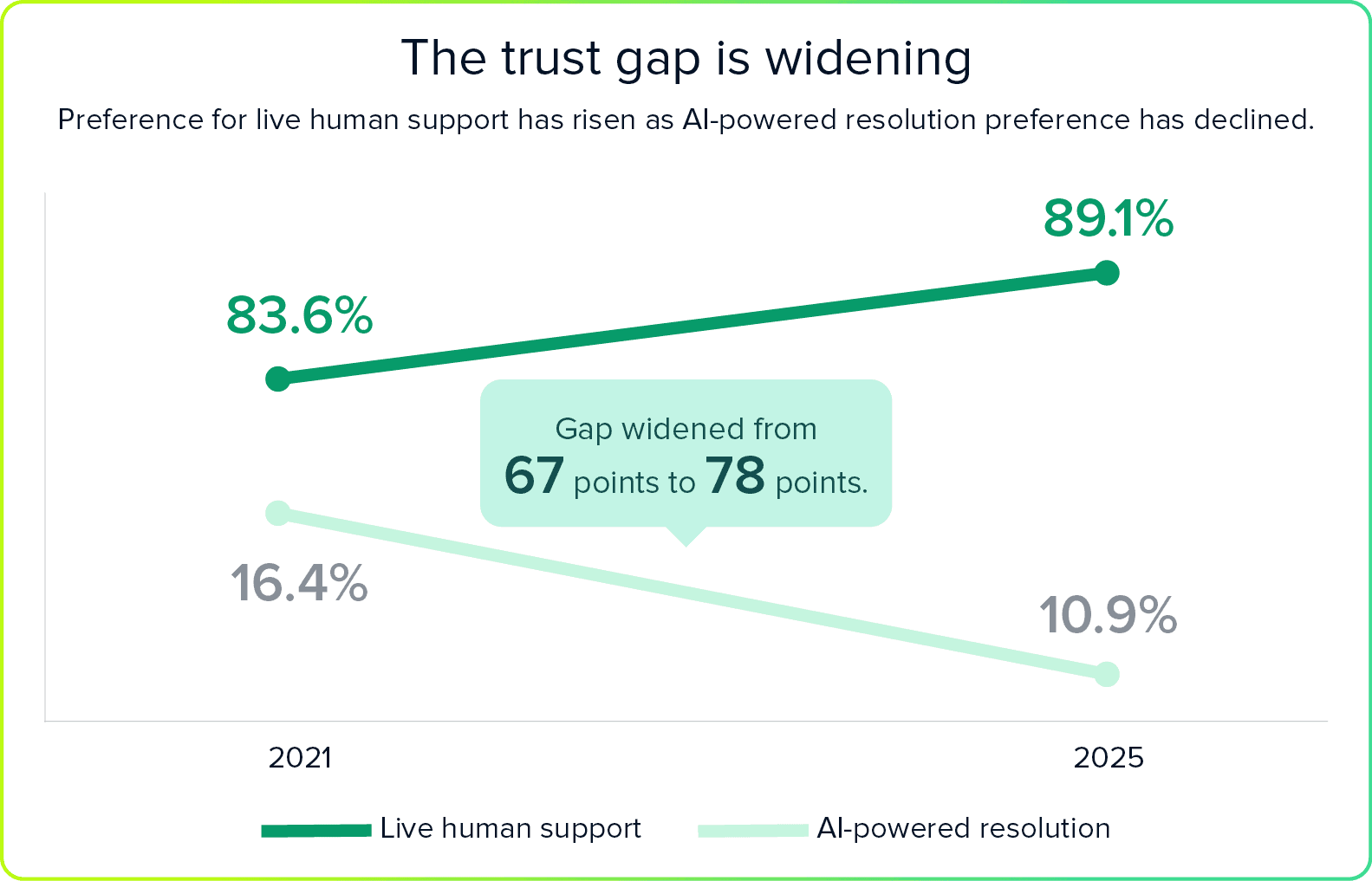
Since 2021, ACI Speedpay has tracked a simple question: If you had to resolve a billing issue, would you rather work with an AI-powered solution or a live human? The answer has moved in one direction, consistently, for five straight years.
Preference for live human support climbed from 83.6% in 2021 to 89.1% in 2025, growing at a compound rate of about 1.6% per year. Over the same stretch, preference for AI-powered resolution fell from 16.4% to 10.9%. The gap between the two didn’t just persist, it widened, from 67 points to 78 points. Outside research mirrors the same pattern: Metrigy found that 84.9% of consumers prefer a human agent over an AI agent; even when assured their issue would be resolved either way, 80.1% still preferred a human.
That shift is happening at the same time AI exposure in billing is accelerating. According to the 2026 ACI Speedpay Pulse Report, more than half of consumers (53.4%) say they have already interacted with an AI-powered billing or support tool. And as that exposure grows, consumers are becoming more decisive. In just one year, the neutral “not sure” middle ground shrank from 36.8% to 32.2%, with consumers forming firmer opinions in both directions.
Consumers are not rejecting AI because it is unfamiliar. They are using it more and becoming more precise about exactly where it helps in managing their household finances. AI can make routine billing faster and easier. But when a payment fails, a charge looks wrong, or an account is suddenly at risk, consumers do not want to feel managed by a system. They want confidence that someone accountable is listening, understanding the context, and can fix the problem as quickly as possible. The risk is treating automation as a destination rather than a critical piece of a more holistic approach to delivering an exceptional payments experience, where humans who are experts in managing payments are critical. The real opportunity is to deploy AI in a way that recognizes when to provide a smooth handoff and bring the human relationship forward.
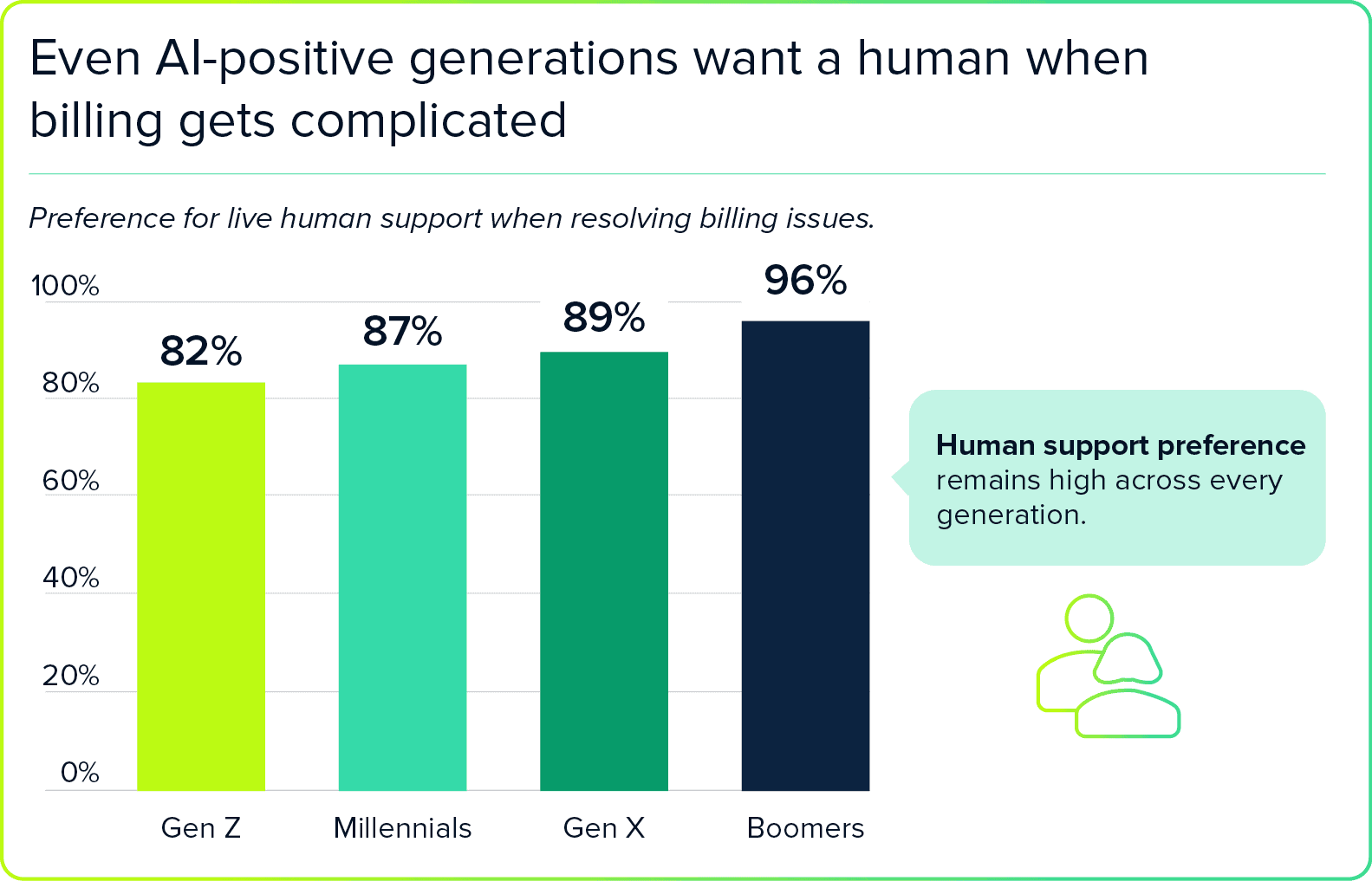
Generational differences exist, but the preference for a human holds across every age group. Gen Z, the most AI-positive consumers in the study, still prefer a live human for billing issues 82% of the time. Millennials prefer humans 87% of the time, Gen X prefer humans 89% of the time, and Boomers prefer humans 96% of the time. Whatever comfort younger consumers have with AI in general, when a disputed charge or a failed payment arises, they need real human contact and real-time resolution. Among Gen Z specifically, phone support (49.3%) and live chat (22.4%) dominate the preferred resolution channels; chatbot and social media support each sit below 1%. Whatever the channel, what matters most is that consumers have the freedom to choose the path that gets them to a person fastest so they can have a live conversation and quickly resolve the issue.
Outside data reinforces it
This is not a quirk of the bill pay category. It is part of a broader pattern showing up across service experiences as companies push more customer interactions through AI. Consumers may appreciate the speed and convenience of automation when the task is simple and transactional. But the movement of people’s money raises the stakes considerably because the interaction is more personal, so timing of payments is everything and directly impacts household stability. When AI feels like a barrier between the consumer and someone who can solve the problem, patience runs out quickly.
Gartner research published in 2024 found that 64% of customers would prefer companies not to use AI for customer service at all. The concern was not simply that AI would get the answer wrong. It was that AI would make it harder to reach a human agent when the customer needed one. That distinction matters because it gets to the heart of the trust issue: Consumers are not just evaluating whether AI can complete a task; they are evaluating whether the company will still be there for them when they need the company most. Trust is critical to long-term loyalty.
Financial pressure adds another layer to this urgency. According to the new ACI/Datos Insights’ 2026 How Americans Pay Their Bills Trend Report, just over a third (36%) of US consumers regularly feel anxious about their bills, and 29% have less than $400 in savings to cover an emergency expense. Trust is also critical to alleviating that anxiety.
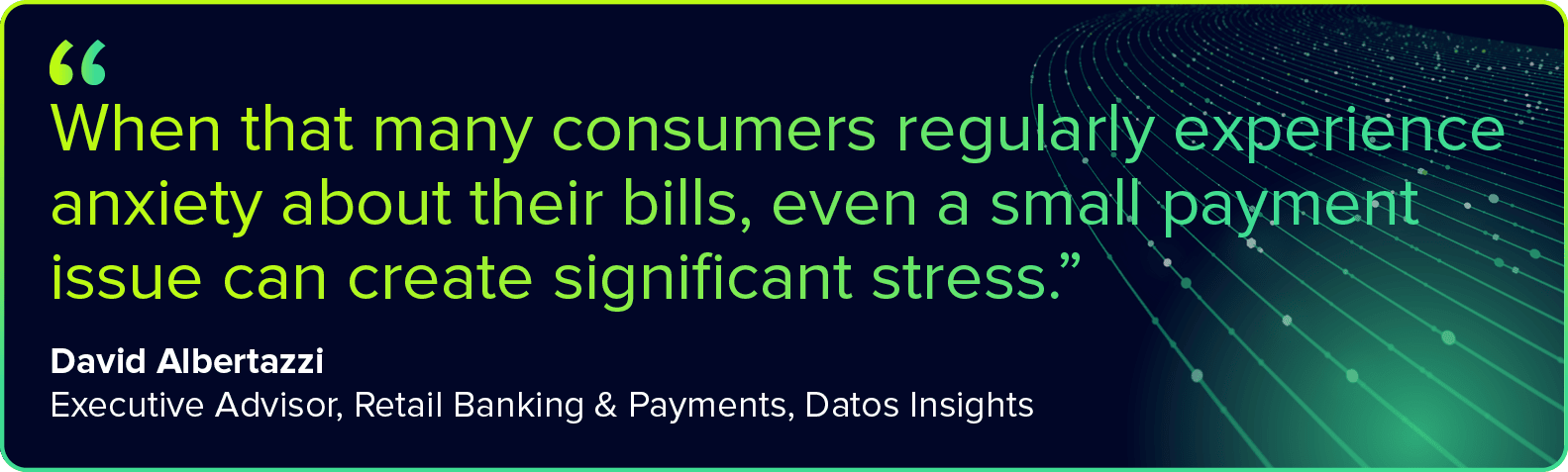
“When that many consumers regularly experience anxiety about their bills, even a small payment issue can create significant stress,” said David Albertazzi, Executive Advisor, Retail Banking & Payments at Datos Insights. “AI can make paying bills faster and easier, but technology alone cannot replace the reassurance and accountability consumers need when something goes wrong. The most effective approach combines the efficiency of automation with the judgment and empathy of human support.”
Taken together with the ACI Speedpay data, the implication is clear: Familiarity with AI is not the same as trust in AI. Greater exposure may make consumers more comfortable using automation for routine moments, but it also makes them more intentional about when they want human involvement, judgment, accountability, and reassurance. For billers, containment should not be the primary measure of AI success. Consumer confidence should be. The most effective AI strategy is one that blends the very best of automation and human intervention.
Trust is built in the handoff
Consumers are already embracing automation for payment confirmations, reminders, notifications, and balance inquiries. AI can provide immediate answers to these routine questions and help people manage their financial lives quickly and with little effort. The expectation changes and the stakes increase when a payment is missed or fails, a charge is disputed, or a billing issue needs to be resolved quickly. Across every generation, consumers want a clear path to a live person.
These are the moments when money, timing, and accountability converge. A questionable charge is not simply an information request, and a failed payment is not merely a workflow problem. A late fee, shutoff notice, or missing confirmation can quickly become a test of the relationship between the consumer and the biller. In those moments, efficiency alone is not enough. In an environment where financial stress and anxiety are heightened, and more US households are living paycheck to paycheck, consumers want context, ownership, and decisive resolution from someone equipped to make the situation right.
Automation earns trust when it is fast, accurate, and nearly invisible. Human support earns even greater trust when the answer requires nuance, accountability, and reassurance. In bill pay, trust is not built only in the easy moments. It is strengthened by how a biller responds when something goes wrong. This is where loyalty is earned.
What this means for billers
For bill pay leaders shaping AI strategy in 2026 and beyond, the temptation is to treat human support as a cost center to shrink. The data points in the opposite direction. Knowledgeable human support is not something modernization should phase out. It is a strategic capability that modernization should make more accessible, better informed, and more valuable when consumers need it most.
The winning formula is not AI or human support. It is AI for the routine and human support for the moments that matter. When AI handles simple things well, it creates speed. When people are ready to step in at the right time, they create trust.
- Automate confidently where consumers already want it. Payment confirmations, balance inquiries, reminders, and predictive charge alerts are exactly the kinds of routine, always-on interactions where AI can reduce effort and make bill pay feel easier.
- Provide live support when the issue feels urgent or unfamiliar. Disputes, failed payments, late fees, shutoff concerns, and unfamiliar charges are not just service tickets. They are trust moments, and they deserve a human path that is fast, informed, supportive, and easy to find.
- Make the handoff visible. Consumers should never have to fight through a bot to reach a person when the stakes are high. The best AI experiences do not trap consumers in automation; they recognize when to escalate right in that moment when a customer needs help and make that next step feel seamless.

Billers that get this balance right can reduce friction while giving consumers more confidence to remain on digital channels, even when something goes wrong. Pathways to a live person need to be created everywhere in the payments experience. That is the leadership opportunity: use AI to make routine moments effortless, then use human expertise to make difficult moments manageable. Modernization should not come at the expense of confidence, accountability, or reassurance. AI and human support do not have to compete. Designed well, they work seamlessly together to create a billing experience that is faster, smarter, and more trusted. The mandate for billers is clear: automate the routine, make escalation seamless, and ensure a knowledgeable person is ready when the stakes rise. To learn how ACI Speedpay helps billers create that balance, request
Related content

Never miss a payment
The next era of bill pay: Meeting customers where they are—and where they are going.

ACI Speedpay Biller Impact Study: A new era in bill pay has arrived
Discover the strategies and innovations shaping the next era of bill payment

The case for lenders to accept debit card payments
There is a strong, growing consumer preference for using debit cards with bill payments, especially among younger generations

Why modern bill pay requires more than the lowest-cost rail
Billers across industries, from mortgage servicing to credit cards, utilities, and insurance, are actively modernizing their bill pay infrastructure.

The modern debit card: The engine behind seamless payments
Cards continue to play a central role in bill pay and recurring payments, giving customers a familiar, trusted way to complete transactions across channels.

Mark leads marketing and partnership efforts within the ACI Speedpay biller business and brings more than 25 years of expertise in enterprise growth strategy, branding, and go-to-market execution within the payments, financial services, healthcare, hospitality, and supply chain industries. He has a proven track record of driving growth through innovative brand strategies, marketing initiatives, and activation programs while managing high-performing teams in various senior leadership roles at large fintech companies, like FIS and Fiserv, among other organizations.