On this page
Key Takeaways
eCommerce is entering a new phase: one where shopping journeys are no longer defined by clicks, tabs, and comparisons. Instead, AI agents are beginning to shop on behalf of consumers: researching products, comparing options, assembling carts, and even completing purchases within pre‑approved boundaries. This shift is known as agentic commerce. What is agentic commerce?
For merchants, agentic commerce doesn’t mean replacing human shoppers. It means understanding how AI for eCommerce is reshaping discovery, decision‑making, and checkout, often in ways that are invisible to traditional analytics.
This article breaks down how AI agents operate across the shopping journey, why this new model is fundamentally different, and what it means for retailers navigating an AI‑mediated future.
How AI shopping agents work?
Agentic commerce refers to a model where AI shopping assistants act as delegated decision makers for consumers. Rather than manually searching, filtering, and checking out, shoppers brief an AI agent on their intent, preferences, constraints, and rules. The agent then does the work.
Think of it as a digital proxy:
This distinction matters. Agentic commerce is not about autonomous systems acting without oversight. It’s about reducing effort, not eliminating choice.
Agentic commerce is here. Are your payments ready?
AI agents are already shopping, assembling carts, and even completing payments. Download the whitepaper to learn how to build an agent-ready payments stack before your competitors do.
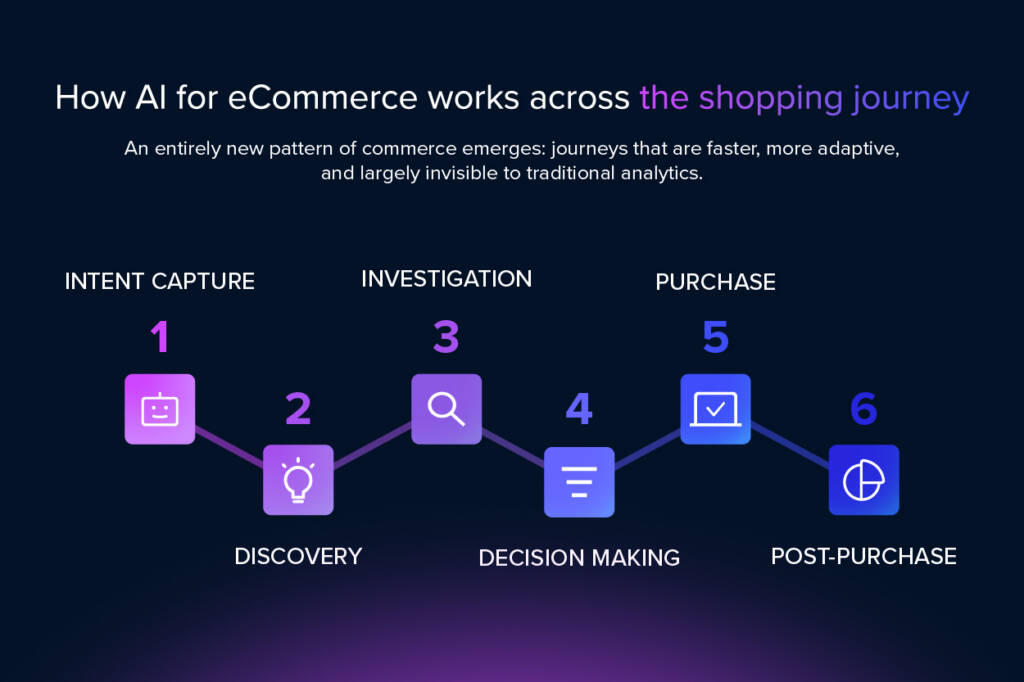
How AI for eCommerce works across the shopping journey
To understand agentic commerce, it helps to break down how AI agents move through the shopping lifecycle. People often think shopping follows a simple, step-by-step path. But agent‑driven journeys are fluid and iterative.
1. Intent capture
The journey begins with intent—but intent is rarely complete at the start.
A shopper might say:
- “Help me find a reliable espresso machine under $400”
- “Restock groceries for a gluten‑free dinner party”
- “Buy running shoes similar to what I wore last year”
At this stage, preferences may be vague. The agent’s job is to clarify, not assume.
2. Discovery
Next, the AI agent searches across retailers, marketplaces, catalogs, reviews, and availability sources. It gathers information at machine speed and returns structured options, not endless lists.
Instead of browsing dozens of pages, the shopper reviews a curated shortlist, often discovering preferences they didn’t articulate initially.
This is where AI retail optimization begins to matter. Agents favor clean product data, consistent attributes, and clear pricing logic.
3. Investigation
Once options are identified, the agent evaluates tradeoffs:
- Features vs. price
- Availability vs. delivery timelines
- Brand trust vs. value
Crucially, the agent explains its reasoning. This feedback loop allows the shopper to refine constraints:
- “Exclude refurbished models”
- “Prioritize energy efficiency”
- “Only buy if it qualifies for free returns”
True intent often becomes clear here, not at the beginning.
4. Decision making
With preferences refined, the shopper approves a direction or sets conditional rules:
- “Buy this if the price drops below $350”
- “Choose Brand A or Brand B, whichever delivers fastest”
- “Only proceed if it ships this week”
Only after preferences are clear does the shopper hand tasks over to the agent.
5. Purchase
If the shopper gives permission, the AI agent initiates checkout using agentic payments—executing transactions within defined spending limits and mandates.
It might buy right away or wait until certain conditions are met, like a price drop. Either way, the shopper stays responsible for the purchase, while the agent handles the execution.
6. Post‑purchase
After checkout, AI agents continue working:
- Tracking deliveries
- Managing returns or exchanges
- Handling substitutions
- Monitoring refunds
Only exceptions, for instance, where only a different model or size is available, require human input. Routine follow‑ups are handled automatically.
The rise of the AI retailer mindset
As agentic commerce grows, retailers must evolve into AI retailers—organizations that design experiences for both humans and machines.
This doesn’t mean abandoning UX. It means complementing it with:
- Machine‑readable product metadata
- Consistent variant definitions
- Clear pricing and availability signals
- Structured APIs that support discovery and checkout
In an agent‑mediated world, clarity beats persuasion. AI agents don’t respond to visual flair or emotional storytelling: they respond to accuracy, consistency, and rules.
Why payment processing matters in an agentic world
As agentic commerce changes how people shop, it also changes how payments need to work. When AI agents find products, build carts, and complete purchases, payments are no longer a single checkout step. They become an ongoing, real‑time process.
Payments orchestration helps manage this by unifying payment providers, methods, fraud checks, and regions into a single layer. This lets merchants route transactions intelligently, manage risk, and stay in control as buying patterns evolve. In AI retail optimization, orchestration keeps machine‑led commerce fast, secure, and scalable for both shoppers and their AI agents.
Agentic commerce across industries
Agentic commerce isn’t limited to consumer retail. Early adoption spans multiple sectors:
- Fashion: AI curates outfits, manages returns, and optimizes size selection
- Home & lifestyle: Agents design rooms and source items across budgets
- Food & grocery: AI manages dietary rules, substitutions, and delivery logistics
- Travel: Agents plan itineraries, monitor prices, and execute bookings
- B2B procurement: AI automates replenishment based on historical patterns
Across categories, the value is consistent: fewer decisions, better outcomes, less effort.
Why this matters now
Momentum of agentic commerce is building fast. As AI tools become more capable and trusted, shoppers will delegate more of the journey, especially repetitive or low‑value tasks.
Merchants who understand this shift early will be better positioned to:
- Interpret new traffic patterns
- Support AI‑driven discovery
- Enable secure agentic payments
- Avoid misclassifying valuable demand as fraud
Those who don’t may struggle to see where conversions are actually coming from.
FAQs
What is agentic commerce in simple terms?
Agentic commerce is a shopping model where an AI agent acts on behalf of a shopper to research products, compare options, build carts, and sometimes complete purchases. The shopper stays in control by setting preferences, rules, and spending limits, while the AI handles the effort. The goal isn’t to remove human decision‑making, but to reduce the time and friction involved in shopping.
How is agentic commerce different from traditional eCommerce?
Traditional eCommerce is built around human actions like clicking, scrolling, and manually comparing products. Agentic commerce replaces much of that effort with AI‑driven evaluation. Instead of navigating websites directly, shoppers increasingly interact with AI shopping assistants that analyze product data, explain tradeoffs, and execute purchases within approved constraints—often without a visible “session” in the browser.
What are agentic payments?
Agentic payments refer to transactions initiated by an AI agent on behalf of a shopper, using pre‑authorized mandates or spending rules. Instead of a person manually entering payment details at checkout, the agent completes the transaction within defined limits. These payments rely on delegated consent rather than traditional human‑present signals like device IDs or browser fingerprints.
How do agentic payments change the role of checkout?
In agentic commerce, checkout becomes a background process rather than a visible step. Payment decisions may happen instantly or conditionally—such as when a price drops or an item comes back in stock. This requires payment systems that can make fast, deterministic decisions and support machine‑to‑machine interactions, rather than relying solely on human confirmation.
Why is payments orchestration important for agentic commerce?
Agent‑driven transactions introduce more variability: different payment methods, providers, risk profiles, and authorization paths depending on the context. Payments orchestration helps manage this complexity by coordinating routing, fraud checks, authorization logic, and settlement from a centralized layer. This allows merchants to support agentic payments while maintaining control, consistency, and performance across channels.
Can existing payment systems support agentic commerce?
Many traditional payment systems were designed for human‑led checkout flows and may struggle with agent‑initiated transactions. Agentic commerce often requires more flexible routing, real‑time decisioning, and the ability to interpret delegated authorization. Merchants increasingly look to orchestration layers to adapt existing payments infrastructure to these new interaction patterns without rebuilding everything from scratch.
How does fraud prevention work when an AI agent is buying?
In agentic commerce, many familiar fraud signals—like cookies or device fingerprints—are no longer present. Instead, risk assessment shifts toward validating agent identity, mandates, behavioral patterns, and transaction context. Payments orchestration platforms can help apply the right fraud logic dynamically, ensuring legitimate AI agents aren’t mistaken for malicious bots.
Does agentic commerce reduce merchant control?
No. While AI agents may execute actions, merchants still define pricing, policies, fulfillment rules, and payments acceptance. The difference is that decisions must be machine‑readable and consistently enforced. Orchestration helps merchants retain control by ensuring agent‑initiated transactions follow the same—or stricter—rules as human‑initiated ones.
Is agentic commerce only relevant for large retailers?
Agentic commerce applies across industries and business sizes—from global retailers to B2B suppliers and digital marketplaces. Any merchant that supports digital discovery and payments may eventually interact with AI agents. The key is readiness: having clean data, clear rules, and a flexible payments infrastructure that can adapt as agent‑driven shopping becomes more common.
Ready to dive deeper into building an agent-ready payments stack?
Download our latest whitepaper: Agentic commerce: The payments shift merchants can’t afford to miss
Related content

The new rules of fashion and sportswear payments
Discover how 3,000 fashion shoppers pay, shop, and return, and what it means for retailer conversion and loyalty.

AI commerce is here—and it’s moving at machine speed
Discover how AI-powered agents are reshaping transaction flows—and what merchants must do to stay competitive, secure, and revenue-ready

The Revenue Hidden in Plain Sight
Learn how to regain one of the largest pools of revenue most merchants already own.

Unlocking Opportunity: How Payments are Powering Merchant Growth
Download the comprehensive report to learn how your peers are future-proofing their payments strategy and unlocking new opportunities to stay competitive in today’s digital-first markets.

PSD3/PSR: What changes for PSPs and how to get operationally ready
Readiness isn’t a legal checkbox. It’s an operational program that touches product design, risk controls, merchant experience, and customer support.
How AI Agents Are Redefining Online Shopping
eCommerce is entering a new phase: one where shopping journeys are no longer defined by clicks, tabs, and comparisons. Instead, AI agents are beginning to shop on behalf of consumers: researching products, comparing options, assembling carts, and even completing purchases within pre‑approved boundaries.

Dennis has more than two decades of experience in the merchant payments space. He leads global innovative product initiatives within ACI, such as tokenization, real-time payments, and many more that support merchants in their digital payments transformation journeys. Before ACI, he worked as a Principal Architect for S1, which ACI later acquired. Dennis is passionate about technology, payments and sports.