On this page
When detection comes late, it gets expensive
For six months, the payments arrive like clockwork. Same amount, same week, no calls to the servicing line. Then the account goes dark. The calls go unanswered. The vehicle isn’t at the address on file. By the time collections are escalated, the lender realizes the payments had been signaling trouble all along, but no one recognized the pattern.
Late detection is costly in every industry. A leading US bank recently faced a penalty of more than $1 billion tied to anti-money laundering failures, with regulators pointing to inadequate detection and reporting. The lesson isn’t about one institution. When detection is slow, the cost compounds.
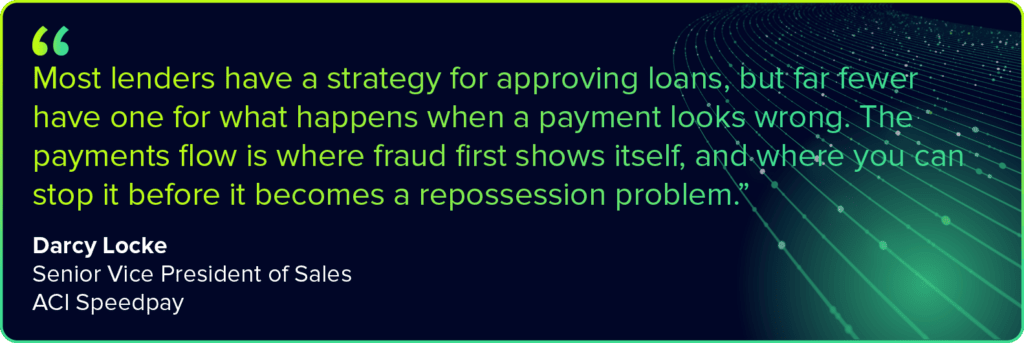
Auto lenders have a version of this problem. They have strong controls at origination, but far less visibility once payments start flowing. They are constantly deciding whether to keep accepting payments, offer assistance, intensify outreach, escalate an account through collections, or begin recovery and repossession. When fraud is mistaken for temporary hardship or ordinary delinquency, each delayed step gives the fraudster more time and makes the eventual loss far more expensive.
The problem: Fraud doesn’t stop at origination
Most fraud conversations focus on the application, but approval is only the beginning. Once an account is active, payments behavior can expose risks that origination controls could not detect. Payments-stage fraud takes several forms:
- Debit card testing: small test transactions that find working cards before bigger fraud follows
- ACH abuse: payments that look legitimate, then reverse or bounce. A failed ACH can surface days after submission, so the account slips further past due before anyone notices, and unauthorized-debit disputes add cost.
- Bust-out activity: coordinated schemes that drain seasoned accounts before the lender sees it coming
- Synthetic identities: profiles “seasoned” over time so they look clean at approval and behave normally, until they don’t
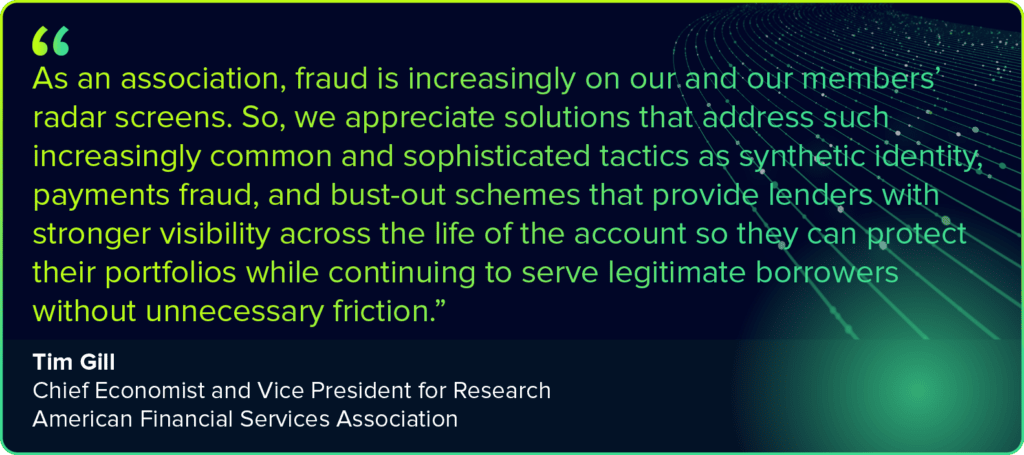
The scale is significant. Point Predictive estimates auto lending fraud exposure reached $10.4 billion in 2025, up from $9.2 billion in 2024, as reported by AFSA. And with US data breach volume up 47% from 2024 to 2025, according to TransUnion, fraudsters have more real data to build convincing borrowers. Industry leaders are taking notice. Tim Gill, Chief Economist and Vice President for Research at AFSA, says fraud is increasingly on the radar of the association and its members.
For subprime lenders, the stakes are higher still. When you own the asset behind the loan, fraud isn’t just a loss problem. It’s a repossession timing problem, and most lenders don’t have a strategy for it yet.
The payments flow is the decision point
Every borrower touches the payments flow, and it’s where behavior shows up first: how, when, and from where someone pays, what changes over time, and whether those changes point to a preventable failure, financial hardship, or potential fraud.
That makes the central servicing question explicit: Is this borrower struggling, or is this fraud or a bust-out? The answer determines whether the right move is outreach and payments support, closer review, collections escalation, or repossession. Get it wrong and you add collections cost, increase recovery loss, or put friction in front of a borrower who was trying to pay.
The cost of the wrong path is well documented. AFSA notes that lenders work with struggling borrowers because repossession is “the costliest resolution for lenders, too,” and that it typically follows months of statements, late notices, default notifications, and outreach.
The difficulty is that struggling borrowers often pay late, partially, or irregularly, so a missed payment alone doesn’t reveal the cause. Servicers already separate three payment problems: a preventable failure (a willing borrower hits a card or processing issue), a timing mismatch (the due date and paycheck don’t line up), and genuine hardship. Fraud is the fourth, and the one most likely to be mistaken for the others. Treating every case alike over-collects from borrowers who were trying to pay.
Bust-out Activity
A coordinated fraud scheme in which a person or group establishes apparently legitimate credit behavior, builds trust with lenders, then takes out multiple loans or acquires multiple vehicles in a short period with no intention of repaying them.
In auto lending, the fraud pattern typically unfolds like this:
- Build trust. The account pays on time, every time, building a clean history that looks like a model borrower.
- Stack the credit. With that history in hand, the same person or group takes out multiple loans or acquires multiple vehicles in a short window.
- Go dark. Payments stop, sometimes after a final round of reversals, and calls go unanswered.
- Disappear. By the time the account reaches collections, the vehicles are no longer where the lender expects them to be.
Point Predictive reports that bust-out fraud has grown 67% over five years, and estimates $250 million to $350 million in annual auto-industry losses. By the time lenders recognize the pattern, the vehicles may already be gone.
This is why the payments layer works:
- Stop it before the loss, not after. Fraud is caught as it happens rather than investigated afterward.
- See the whole picture. Real-time behavior across web, mobile, IVR, and in-person channels reveals what point solutions miss.
- Get visibility bureau data can’t provide. Neither can dealer systems.
- Support your AML posture. Payments can be a channel for moving illicit funds, so monitoring at the payments layer supports a lender’s broader AML efforts.
Layering protection across origination and payments
Origination controls remain essential. They screen applicants and catch identity risk before approval. Payments-stage protection doesn’t replace them. It extends protection through servicing, collections, and recovery, where legitimate-looking accounts change over time. After booking, payments behavior, funding-account changes, reversals, and channel activity can reveal risks that were invisible at application.
Because this protection is native to the payments flow, lenders can add the layer without waiting on a separate origination integration, and without the delay and complexity of bolting on another point solution. The outcomes are the ones executives care about: earlier detection of accounts going bad, fewer unnecessary repossessions, lower recovery and collections costs, and more confidence to grow responsibly.
The four pillars in action
Peace of mind. AI-powered fraud management in the payments flow, backed by multiple tiers of resiliency, means you stop worrying about what you can’t see.
Continuous growth. Fewer payments-stage losses mean more confidence to expand into new segments, including subprime. New payment options, such as digital wallets and alternative methods, can be supported without opening the door to new fraud exposure.
Smarter operations. Better, earlier decisions in collections and repossession cut unnecessary cost, and automated workflows connect the call center, collections, and payment operations.
Optimal customer experiences. Legitimate borrowers pay any way, anywhere, across every channel, with fewer false declines, so protection never punishes good customers.
By the numbers
34% of bill payers say stronger fraud protection would make them more likely to use debit for bills, rising to 37% among adults 55 and older.
Source: 2026 ACI Speedpay/YouGov Consumer Debit Trend Report
Never miss a payment: Protection without friction
The goal isn’t simply to stop fraud. It’s to stop fraudulent activity while legitimate payments keep flowing, so willing borrowers stay current. One failed payment can become a late fee, a service call, a delinquency event, and a break in trust. “Never miss a payment” is the standard borrowers now hold lenders to.
As David Williams writes in his blog, Why lenders should treat debit as a strategic payments rail: “Consumers expect protection, but they do not want security controls to slow them down.” The best protection works in the background and keeps payments fast and familiar. And it only matters if the platform is always available, which is why fraud intelligence must be paired with multiple layers of resiliency and deep payments expertise. For the lender, that means steadier, more predictable cash flow.
Six questions to ask your team
- Can we distinguish between a borrower experiencing financial hardship and an account showing signs of fraud?
- Where does payments-stage fraud data live, and can servicing, collections, and fraud teams access it when making decisions?
- Which changes in payments behavior trigger additional review or outreach today?
- How quickly can we identify suspicious cards, ACH, device, or account activity before a payment is accepted?
- What does a delayed collections, recovery, or repossession decision cost us per account, and how often does it happen?
- Who owns the response when suspicious payments activity is detected, and are the next steps clearly defined?
See it before the fraudsters do
Fraudsters look for the weak brick early. Your job is to make sure they don’t find one.
That’s the thinking behind ACI’s approach to payments fraud. ACI Fraud Management brings real-time fraud intelligence into the ACI Speedpay payments flow. Every payment is evaluated before it’s approved, using risk scoring, rules, and machine learning, behavioral profiling of the payer, card, device, and IP, and network intelligence drawn from patterns across ACI’s broader transaction network. Card testing, account takeover, and suspicious ACH activity are flagged in the moment. Legitimate borrowers sail through without added friction. Fraud specialists keep tuning strategies as the threats change.
It doesn’t replace your origination controls. It gives your servicing, collections, and fraud teams a real-time read they rarely have today: visibility into the one moment every borrower touches, so you can tell hardship from fraud earlier, cut payments-stage losses, and protect the cash flow that keeps willing borrowers on the road.
It’s backed by three tiers of resiliency, more than 50 years of payments expertise, more than 3,000 billers served, and 24/7/365 support.
Build a stronger fraud defense with ACI Speedpay and see how payments intelligence can guide smarter decisions across fraud prevention, collections, and repossession. Start a payments fraud blind spot conversation with us to identify potential vulnerabilities in your payments flow and learn how ACI Fraud Management brings real-time fraud intelligence to ACI Speedpay.
Related content

Never miss a payment
The next era of bill pay: Meeting customers where they are—and where they are going.

ACI Speedpay Biller Impact Study: A new era in bill pay has arrived
Discover the strategies and innovations shaping the next era of bill payment

The case for lenders to accept debit card payments
There is a strong, growing consumer preference for using debit cards with bill payments, especially among younger generations

Why modern bill pay requires more than the lowest-cost rail
Billers across industries, from mortgage servicing to credit cards, utilities, and insurance, are actively modernizing their bill pay infrastructure.

The modern debit card: The engine behind seamless payments
Cards continue to play a central role in bill pay and recurring payments, giving customers a familiar, trusted way to complete transactions across channels.

Brian Donovan is a Senior New Business Developer with ACI Speedpay, focused on helping auto lenders and other consumer finance organizations modernize payment experiences, strengthen fraud defenses, and improve servicing outcomes. He works with financial institutions to connect payments strategy with the operational priorities of collections, customer experience, and responsible growth.