On this page
In early May 2026, the US national average price for regular gasoline climbed past $4.50 per gallon, reaching its highest level in nearly four years. According to AAA, drivers are now paying an average of $4.552 per gallon nationally, with prices exceeding $6 in California.
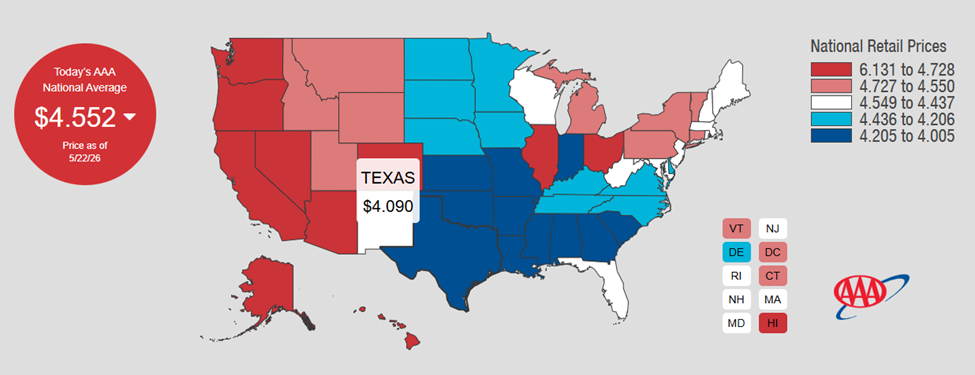
Image source: Screengrab from gasprices.aaa.com | May 22, 2026
For drivers, it’s sticker shock—again. For fuel retailers, it’s a signal.
High gas prices don’t just affect how much consumers pay at the pump. They change how often people drive, where they stop, how carefully they compare prices, and what they buy when they do. As volatility returns to fuel markets in 2026, those behavioral shifts are already reshaping traffic patterns, loyalty, and in-store performance across the US.
An AAA survey confirms this pattern: 59% of drivers say they would change their driving habits once gas exceeds $4 per gallon—a threshold that is now a reality across the country, not just California, as it was two months ago.
These behaviors also reinforce several of the broader fuel and convenience trends shaping 2026, especially the growing role of loyalty and digital engagement.
Fewer trips, more deliberate decisions
When gas prices climb, consumers don’t immediately stop driving; they just drive smarter.
According to Ipsos’ March 2026 Consumer Tracker:
For fuel merchants, this has a simple implication:
Every visit matters more.
Fewer trips mean fewer chances to win fuel volume and in‑store spend. Traffic often softens, making reliance on “drive‑by” convenience increasingly risky during high‑price periods.
Price becomes the first filter
Fuel has always been competitive, but when prices surge, price awareness intensifies.
Drivers are now:
- Checking prices before leaving home
- Using apps like GasBuddy to comparison‑shop in real time
- Making stop decisions based on a quick glance at roadside signage
For merchants, this reinforces a hard truth: When prices rise above psychological thresholds ($4, $4.50, $5), price perception often outweighs brand preference, especially for longer or planned drives.
When gas prices rise, price perception often outweighs brand preference.
This doesn’t mean racing to the bottom, but it does mean being intentional about:
- Clear, accurate pricing
- Loyalty‑based discounts
- Fair communication
Irving Oil, a major merchant in the Northeast, has taken its loyalty discounts a step further by doubling the discount rate to help customers manage recent price increases. The key: the company clearly communicated that the enhanced discount is available for a limited time, preventing it from becoming the new baseline expectation.
Where payments connect
When price drives choice, loyalty drives retention. That only works if loyalty is recognized instantly across the pump, the store, and mobile, requiring unified payments and customer identity. Without that, loyalty can’t counterbalance price sensitivity.
Inside store spend feels the pressure
Research indicates that when gas prices rise 10%, discretionary spending at nearby retail locations can fall by up to 5%. Fuel acts like a hidden tax—crowding out snacks, drinks, and impulse buys. That means:
- Fewer impulse purchases
- Smaller baskets
- Greater focus on essentials or promotions
Unless merchants offer a clear reason to buy, in‑store spend shrinks faster than fuel demand.
Loyalty is still possible, but it has to be earned
Even in volatile pricing environments, consumers don’t want to hunt endlessly for fuel. Many still prefer familiar stations, as long as they feel respected and rewarded.
GasBuddy’s national survey shows that
- 81% of Americans regularly go to the same gas station
- High prices weaken that loyalty if savings aren’t visible. 76% of drivers admit they’ve bought gas only to pass a cheaper station moments later.
What breaks loyalty during a time of high gas prices isn’t just the price itself—it’s surprise, regret, and lack of transparency. Drivers who feel they overpaid or missed a better option nearby are far less likely to return.
To be better positioned to retain traffic, even when prices rise, merchants need to pair competitive pricing with:
- Clear value messaging
- Loyalty or rewards programs
- Consistent customer experience
Why payments matter
Most loyalty failures in fuel are not marketing failures; they’re identity failures. Without unified customer identity across forecourt, store, backcourt, car wash, mobile, and more, retailers cannot deliver the seamless recognition that price-sensitive consumers expect when gas is expensive. Loyalty only works if systems recognize the customer instantly.
The optimal way to ensure customer identity across the station is to directly connect payments and loyalty systems using payment omni-tokens and PAR as the primary key in the loyalty system of choice.
What this means for fuel merchants
High gas prices are unavoidable. Losing customers doesn’t have to be. The merchants who perform best in these environments understand that:
- Consumers are driving less
- Price perception shapes behavior instantly
- Loyalty weakens without visible value
- Every visit is more valuable than the last
- No transaction should be allowed to fail; every payment decline represents a bigger future loss
The bottom line
When gas prices rise, consumer habits don’t disappear—they evolve. Fuel merchants who adapt to those shifts can protect traffic, preserve loyalty, and stay competitive even in the toughest pricing environments.
Under high-price conditions, payments become the operating system of the forecourt. The merchants who perform best are the ones who treat payments as infrastructure, not as a back-office necessity. Reliability, identity, and fraud protection become competitive advantages when every visit counts and every dollar is scrutinized.
What to do next: practical actions for fuel merchants
High gas prices aren’t something merchants can control, but how you respond to shifting consumer behavior is. The most resilient fuel retailers focus on clarity, value, and relevance.When prices rise, execution matters more. Here’s where to start:
- Make value obvious, fast
- Clear, comparable pricing signage
- Time‑bound loyalty discounts tied to price spikes
- No surprises at the pump
- Maximize every visit
- Visible in‑store and combo offers
- Top sellers and high‑margin items upfront
- Friction‑free basics (pumps, restrooms, coolers)
- Use loyalty to offset price pain
- Promote loyalty at the pump and in‑store
- Emphasize cumulative savings, not cents
- Connect fuel to in‑store rewards
- Watch who pulls back first
- Track volume by daypart/location
- Expect earlier drops in lower‑income or rural areas
- Adjust staffing, promotions, inventory quickly
- Protect trust
- Calm, empathetic staff
- No defensive pricing explanations
- Lead with service, cleanliness, convenience
When trips decline and scrutiny rises, merchants must deliver clear value with fewer mistakes and zero friction, because prices change daily, but the experience shouldn’t.
In volatile markets, speed and adaptability shift from reactive tactics to true competitive advantages. Learn how ACI helps fuel merchants stay ahead with purpose-built payment solutions.
Related content

The new rules of fashion and sportswear payments
Discover how 3,000 fashion shoppers pay, shop, and return, and what it means for retailer conversion and loyalty.

AI commerce is here—and it’s moving at machine speed
Discover how AI-powered agents are reshaping transaction flows—and what merchants must do to stay competitive, secure, and revenue-ready

The Revenue Hidden in Plain Sight
Learn how to regain one of the largest pools of revenue most merchants already own.

Unlocking Opportunity: How Payments are Powering Merchant Growth
Download the comprehensive report to learn how your peers are future-proofing their payments strategy and unlocking new opportunities to stay competitive in today’s digital-first markets.

PSD3/PSR: What changes for PSPs and how to get operationally ready
Readiness isn’t a legal checkbox. It’s an operational program that touches product design, risk controls, merchant experience, and customer support.
How AI Agents Are Redefining Online Shopping
eCommerce is entering a new phase: one where shopping journeys are no longer defined by clicks, tabs, and comparisons. Instead, AI agents are beginning to shop on behalf of consumers: researching products, comparing options, assembling carts, and even completing purchases within pre‑approved boundaries.

Terry is a seasoned marketing professional with over 30 years of experience. While he has worked in payments for only five years, he has experience with both eCommerce and omnichannel merchants as well as with payment intermediaries. He enjoys building and repairing things with his hands and coming up with innovative ideas to solve complex problems.