On this page
Only 25% of retailers treat payments optimization as a board-level priority, even though 70% say it’s important. That gap between recognition and execution is where revenue is leaking.
And the sums are not small. According to ACI Worldwide’s internal data, a 3% uplift in acceptance rate is worth roughly $30 million for every $1 billion in processing volume. For most merchants, that isn’t theoretical upside, it’s revenue already sitting inside existing payment flows, waiting to be reclaimed.
A new survey of over 200 merchants and retailers across Europe and North America, commissioned by ACI Worldwide and conducted by Retail Systems, pinpoints why so many retailers are leaving that money on the table, and what the top performers do differently. Below are the six findings that matter most, and what each one means if you’re trying to recover hidden revenue through smarter payments optimization.
First, what is payments optimization for retailers?
Payments optimization is the practice of improving every stage of the transaction lifecycle—checkout, authorization, routing, settlement, and decline recovery—to increase the percentage of successful payments while reducing cost and fraud. For merchants, it directly impacts revenue, customer experience, and operational efficiency. Even small gains compound across millions of transactions.
Top findings:
1. Retailers focus on cost, while revenue gains remain under-measured
60% of retailers still track payment processing cost reductions, but only 37% directly measure the revenue uplift that optimization generates.
Cost is being tracked nearly twice as often as revenue.
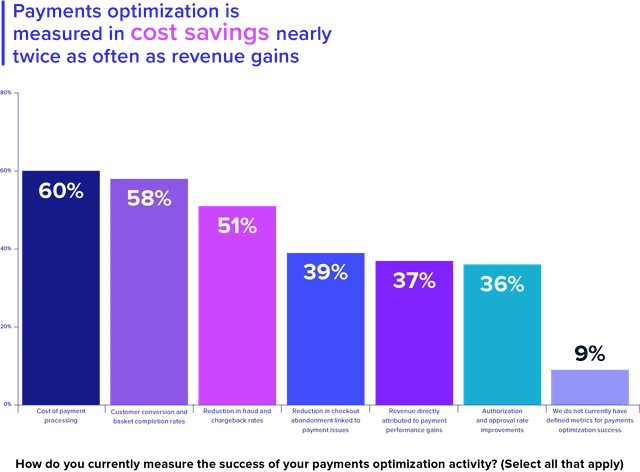
Without clear revenue attribution, investment in payments is harder to justify, even when optimization improves conversion and acceptance rates
So, which payment KPIs should retailers track in 2026? Top performers track:
- Approval rate
- Soft decline recovery
- Revenue uplift alongside cost, not instead of it.

Tip: Reframe your metrics around the revenue payments optimization generates, not just the cost it saves.
2. Most retailers are underperforming on payments
Only 30% of retailers believe they are at or above benchmark. The rest report known gaps, limited visibility, or no benchmarking process at all.
There is a clear performance gap across the sector, resulting in missed transactions, lost sales, and unrealized revenue. Retailers that don’t benchmark can’t tell whether their losses are ordinary market friction or fixable problems in routing, acquiring, or 3DS configuration. This means they can’t tell what’s worth fixing
What the strongest performers do: In the survey, perceived performance and prioritization move together. The strong-performing 30% tend to be the same organizations that treat optimization as a genuine priority rather than an afterthought.
3. Payments optimization is recognized but not given the priority it merits
70% consider payments optimization important, but only 25% give it a board-level priority. Awareness is high but execution is inconsistent, so optimization competes with other initiatives and struggles to secure investment.
The disconnect usually comes from how payments are framed internally. When payments are positioned as a cost center, they fight for budget. When they’re positioned as a revenue lever, they attract executive sponsorship and get the funding required to compound results.
Tip: Position payments as a revenue lever rather than a cost center.
4. Resource constraints are the primary barriers blocking payments optimization progress
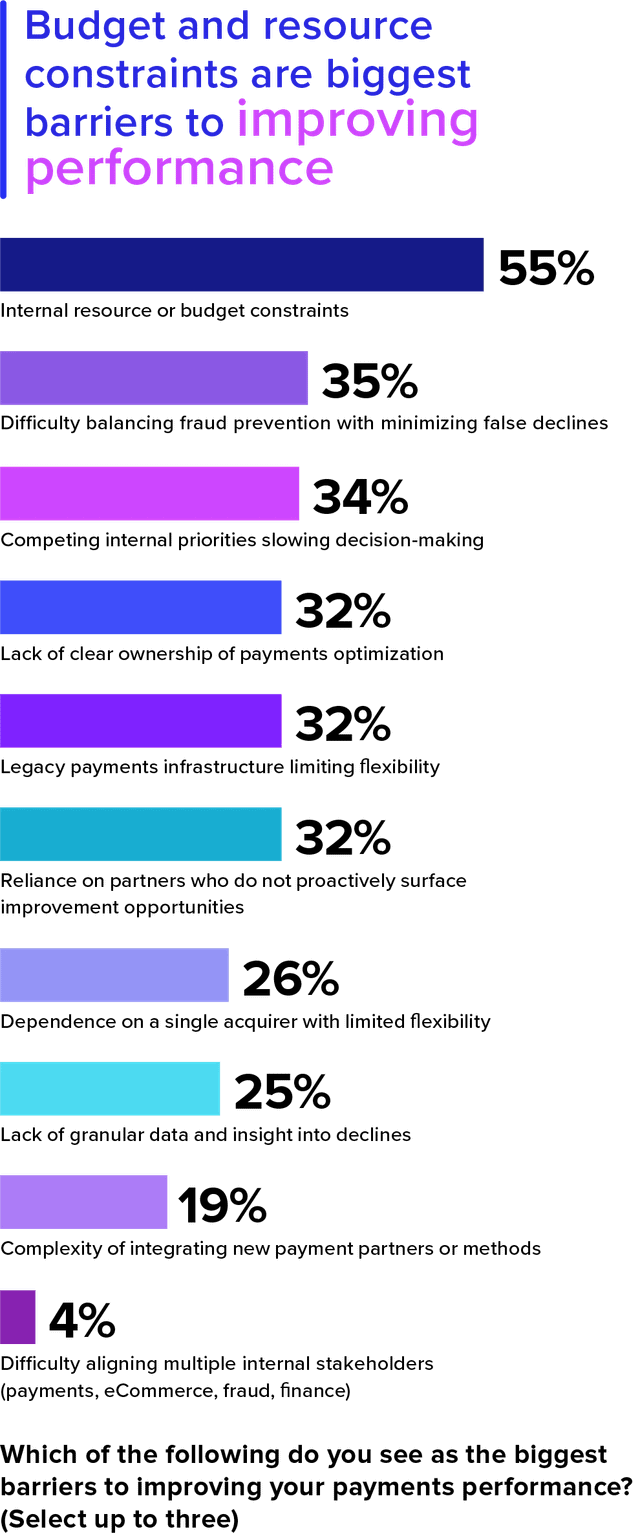
55% cite budget or resource limitations, with many admitting they’re aware of performance gaps they simply can’t address. So, even when opportunities are identified, retailers lack the capacity to act, resulting in ongoing revenue leakage.
This is the gap between knowing and doing and it’s the single biggest reason revenue keeps leaking through avoidable declines and suboptimal routing. Resource constraints compound because optimization requires both technical capacity and ongoing operational ownership. Without both, even validated improvements stall in backlog.
Tip: Make the ROI case in revenue terms when competing for budget.
5. Retailers rely on external partners for optimization
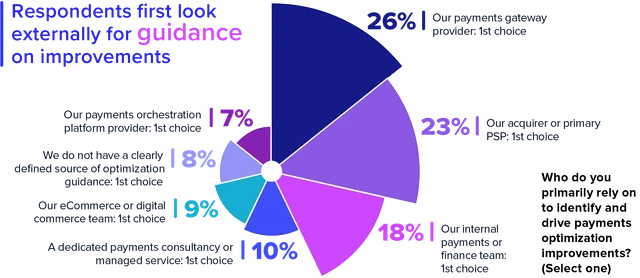
Providers, gateways, and partners play a central role in driving efforts. Yet, 4 in 10 cited reliance on partners who don’t suggest improvements as a top 3 barrier to improving payments performance. This reliance is compounded by fragmented internal ownership across multiple teams. When optimization is not centrally owned, it’s harder to measure impact, coordinate improvements, and scale results.
Insight
Top performers have high-level internal ownership and visibility, relying on systems partners for analytics, changes, and reporting. They turn to outside counsel when they lack specific internal expertise.
6. Orchestration adoption is accelerating
57% plan to implement or expand payments orchestration. Orchestration is gaining ground because it solves the structural problems behind the other five findings: it centralizes ownership, makes performance measurable, enables intelligent routing across providers, and reduces the engineering burden of testing optimizations.
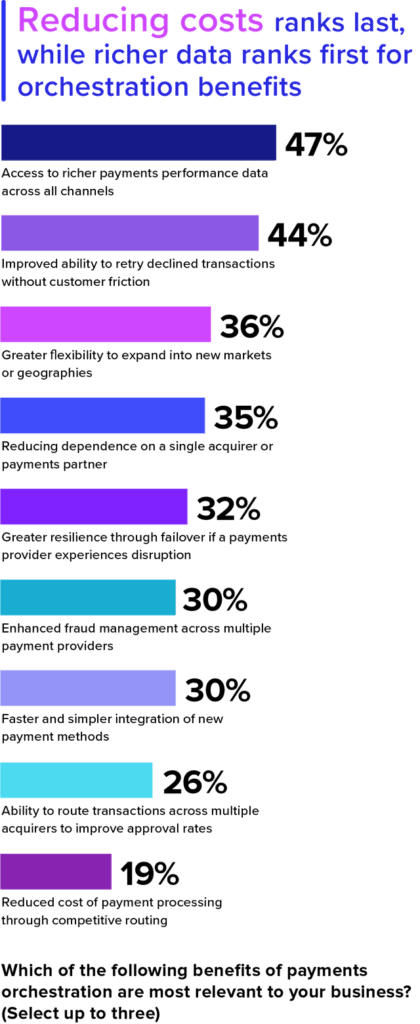
The implementation of payments orchestration shows a natural maturity in payments optimization of seeking more complex methods to unlock hidden revenue.
The bottom line for retailers
This all points to a gap between potential and execution that’s leaving significant revenue hidden in everyday payment flows. To begin fixing this, retailers need to:
- Reframe the business case for payments optimization in terms of revenue uplift, not just cost reduction
- Invest in data analytics and AI for visibility on optimization improvements for maximum return
- Align teams around shared performance and revenue metrics
- Fill resource and capacity gaps with external expertise instead of stalling
- Adopt payments orchestration to scale improvements and consolidate fragmented systems and data
While payments optimization is widely recognized as critical, most retailers are not capturing its full value. Revenue is being lost through avoidable declines, suboptimal routing, and underperforming payment strategies. Retailers that elevate payments optimization into a strategic revenue lever, with the right metrics, ownership, and technology, will outperform peers in customer experience and topline growth.
Don’t just take my word for it; get a copy of the report to see how your organization compares to your peers.
FAQs
What percentage of retailers prioritize payments optimization?
Only 25% of retailers treat payments optimisation as a board-level priority, though 70% consider it important, according to a 2026 survey of more than 200 merchants across Europe and North America.
How many retailers meet payment performance benchmarks?
Only 30% of retailers believe they are at or above benchmark on payments performance, with the remainder reporting known gaps or limited visibility.
What is the biggest barrier to payments optimization?
Budget and resource limitations are the top barriers, cited by 55% of retailers in the 2026 survey, even when optimization opportunities have already been identified.
What percentage of retailers use payments orchestration?
57% of retailers plan to implement or expand payments orchestration, reflecting broader market adoption that’s growing at roughly 18–24% CAGR through the early 2030s.
Do retailers measure revenue uplift from payments optimization?
Only 37% of retailers directly measure revenue uplift from payments optimization, while 60% track cost reductions, creating an attribution gap that makes optimization investment harder to justify.
What’s the difference between payments optimization and payments orchestration?
Payments optimization is the goal—improving authorization rates, reducing declines, and recovering revenue. Payments orchestration is one of the most common methods to achieve it, by centralizing routing, providers, and data across the payments stack.
The revenue hidden in plain sight
Closing the retail payments optimization gap. Discover where payment performance gaps are costing retailers revenue, conversion, and customer loyalty.
Related content

The new rules of fashion and sportswear payments
Discover how 3,000 fashion shoppers pay, shop, and return, and what it means for retailer conversion and loyalty.

AI commerce is here—and it’s moving at machine speed
Discover how AI-powered agents are reshaping transaction flows—and what merchants must do to stay competitive, secure, and revenue-ready

The Revenue Hidden in Plain Sight
Learn how to regain one of the largest pools of revenue most merchants already own.

Unlocking Opportunity: How Payments are Powering Merchant Growth
Download the comprehensive report to learn how your peers are future-proofing their payments strategy and unlocking new opportunities to stay competitive in today’s digital-first markets.

PSD3/PSR: What changes for PSPs and how to get operationally ready
Readiness isn’t a legal checkbox. It’s an operational program that touches product design, risk controls, merchant experience, and customer support.

How AI Agents Are Redefining Online Shopping
eCommerce is entering a new phase: one where shopping journeys are no longer defined by clicks, tabs, and comparisons. Instead, AI agents are beginning to shop on behalf of consumers: researching products, comparing options, assembling carts, and even completing purchases within pre‑approved boundaries.

Terry is a seasoned marketing professional with over 30 years of experience. While he has worked in payments for only five years, he has experience with both eCommerce and omnichannel merchants as well as with payment intermediaries. He enjoys building and repairing things with his hands and coming up with innovative ideas to solve complex problems.