On this page
Fashion and sportswear retailers have never had less room for error. Global apparel growth is expected to stay under 1% CAGR through 2030, while sportswear keeps outpacing the wider category1, and cost-conscious shoppers are getting far more selective about where their money goes. In that kind of market, the old assumptions about loyalty, seasonality, and channel behavior stop being reliable.
So, we went straight to the source. ACI Worldwide commissioned YouGov to survey 3,000 fashion and sportswear shoppers across the US and UK, digging into how they shop, how they pay, and what makes them stay or walk away. The full findings live in our 2026 Fashion Consumer Trends Report, but here are the key signals every merchant selling fashion or sportswear should know about.
Impulse and urgency have replaced the season as the real demand driver
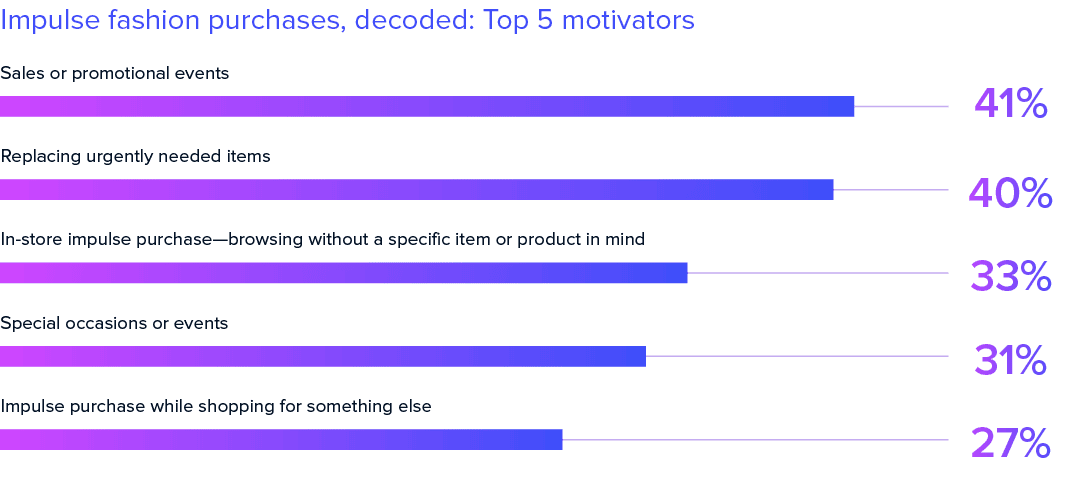
Seasonality still matters, but it’s no longer the main event. 41% of shoppers say they make impulse purchases in response to sales or promotions, and that jumps to 49% among sportswear buyers specifically. Urgent replacement of an existing item runs a close second at 40%. Social media and influencer trends are an outsized driver for 18- to 24-year-olds, who are twice as likely as the average shopper to buy on impulse because of what they saw online.
The takeaway for retailers
Demand now spikes on short notice, and the operational and payments infrastructure behind checkout must be able to absorb that volatility without buckling.
Shoppers don’t follow one path to purchase anymore
More than a third of shoppers (35%) now buy online and collect in-store, and 15% use a retailer’s app to purchase while standing in the store itself. Women lead this shift by a wide margin, buying online and collecting in-store at nearly one-and-a-half times the rate of men (41% vs. 28%). Sportswear shoppers go even further, blending online and offline behaviors more than any other group we surveyed.
The variability of hybrid shopping
| Ways people shop for clothing, footwear, or fashion items | Overall |
|---|---|
| Buy online for home delivery | 68% |
| Buy online, collect in-store | 35% |
| Buy online, return in-store | 28% |
| Buy in-store, return by post/courier | 20% |
| Place an order in-store for home delivery or store collection | 18% |
| Use retailer app in-store to order or purchase | 15% |
The takeaway for retailers
Hybrid shopping isn’t a niche behavior anymore; it’s the default. Retailers that can’t recognize the same customer, their saved payment details, and their order history across web, app, and in-store are going to lose the channel-agnostic experience shoppers now expect.
Interested in finding out which country reports higher hybrid-shopping rates?
A good app doesn’t just retain shoppers, it changes how they shop
34% of shoppers use retailer apps specifically because they make shopping easier, and that number climbs up to 44% among sportswear shoppers. Women are far more likely than men to value what apps offer, from easier browsing (41% vs. 27%) to order tracking, returns management, and saved payment credentials.
Personalization is still a minority interest overall (11%), but it’s nearly five times more valuable to 18- to 24-year-olds than to 55- to 65-year-olds, a shopping behavior that’s only likely to widen as younger shoppers gain spending power.
The takeaway for retailers
Easier browsing, frictionless checkout, and a 360-degree view of orders and account activity regardless of channel turn app engagement into loyalty.
Payment preference is not one-size-fits-all, even between two similar markets
Card payments top the list both in-store and online, but the mix is different on both sides of the Atlantic.
In-store:
- UK shoppers lean harder into debit cards (71%) and digital wallets (34%), while US shoppers favor credit cards (48%) and cash (47%).
Online:
- UK shoppers lean on debit cards (67%) and digital wallets (39%), while US shoppers favor credit cards (54%) and cash on delivery, (13%) more than their UK counterparts.
- Digital wallets see their strongest adoption among 18- to 24-year-olds; 51% prefer them online.
- The gap narrows for some methods: PayPal (35% US vs. 34% UK) and BNPL (19% both).
The takeaway for retailers
If a retailer’s payment mix is optimized for one market and rolled out unchanged to another, it’s leaving conversions on the table. Retailers need to rapidly add new preferred payment options and localize payments to keep pace with fast-changing consumer preferences.
Checkout friction is costing retailers real revenue
This is one of the most fixable problems in the entire survey. 39% of shoppers will abandon a purchase outright if their payment fails, and a surprise cost that shows up at checkout pushes that number even higher, to 40%.
Fashion2 already carries one of the highest cart abandonment rates of any retail category, with recent industry benchmarking putting it well above the cross-sector average of roughly 70% globally, driven in large part by exactly these moments of friction.
Response to payments failure
| Response | Overall | US | UK |
|---|---|---|---|
| Try a different payment method | 53% | 61% | 48% |
| Try again using the same payment method | 47% | 43% | 49% |
| Try to complete the purchase later | 42% | 35% | 46% |
| Give up on the purchase altogether | 39% | 40% | 38% |
| Purchase from another retailer | 22% | 22% | 23% |
The takeaway for retailers
Most causes of cart abandonment and payment failures are addressable. Payments optimization is the fastest path to revenue recovery, leveraging data across the full payments journey to boost approvals and convert the traffic retailers already worked hard to generate. For large retailers, even small gains in acceptance rates can translate into millions in recovered revenue.
Returns are a trust problem as much as a fraud problem
Returns are expensive for the industry overall. The National Retail Federation projects retailers will absorb nearly $850 billion in returned merchandise this year3, with roughly 9% of all returns classified as fraudulent. It’s tempting to respond with stricter policies, but our survey suggests that’s the wrong lever: 55% of shoppers say stricter return policies would push them to shop elsewhere entirely.
The takeaway for retailers
The fix is already sitting in the data. 79% of shoppers agree that better sizing information, product detail, and reviews, not tighter rules, would cut down on unnecessary returns in the first place. That’s a customer-experience fix, not a policy fix, and it protects loyalty while still addressing genuine abuse through better fraud analytics rather than blanket restrictions.
AI is starting to earn trust through practical assistance—for now
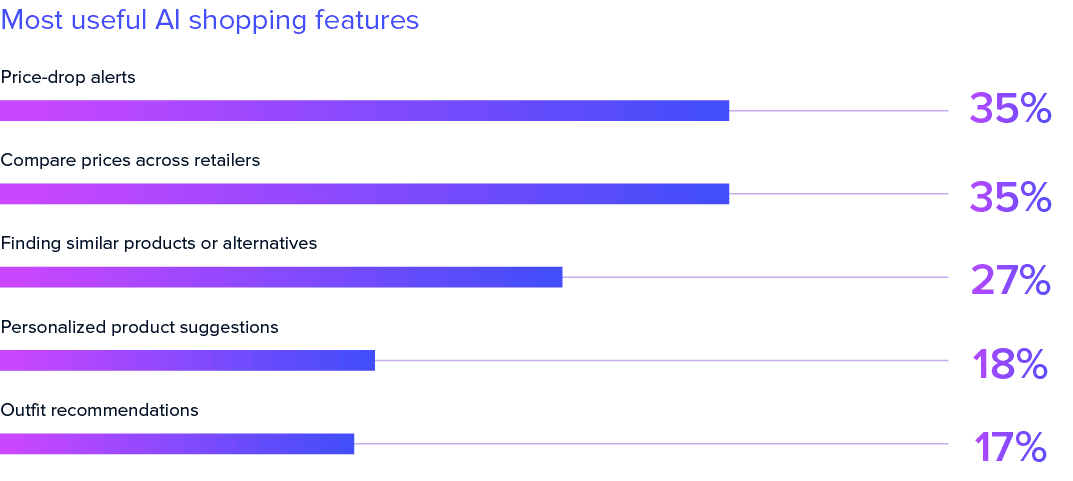
Shoppers are cautious about full autonomy but are increasingly comfortable with a certain kind of AI. 35% already see value in AI-driven price-drop alerts and cross-retailer price comparisons, which stand out as the two most trusted entry points into agentic commerce. Interest in AI helping find similar products (27%) and, for younger shoppers, personalized recommendations (25% among 18- to 24-year-olds vs. 18% overall) is real but more modest.
Full autonomy is a much harder sell. 53% of shoppers say they’re not comfortable letting AI purchase on their behalf under any circumstances. That caution matters, but retailers shouldn’t read it as a reason to ignore agentic commerce altogether. AI-referred shopping traffic is already converting meaningfully better than traditional search in early 2026 data: Adobe Analytics measured a 42% conversion lift4 for AI-referred visitors compared with non-AI traffic.
The takeaway for retailers
AI agents are already browsing retailer sites on shoppers’ behalf. Retailers need to expose their catalog, distinguish good agents from bad bots, and partner with a payments provider that can get them ready for agentic shopping.
The shoppers retailers need most are also the least forgiving
Some interesting patterns cut across the survey: Women and 18- to 24-year-olds shop the most often, lead hybrid shopping and app adoption, and are the highest-value audience for loyalty investment.
At the same time, they’re the fastest to walk when something breaks. Women abandon purchases after a payment failure at meaningfully higher rates than men (43% vs. 33%), and younger shoppers are quick to leave when a policy or checkout doesn’t meet them where they are.
Sportswear shoppers are a category apart, and worth watching closely. They place greater value on app features most closely linked to loyalty, and they are especially receptive to personalized recommendations.
The takeaway for retailers
Those optimizing their experience for the “average” shopper are, in effect, under-serving the customers who matter most to their growth.
Payment implications: The thread connecting all findings
Demand is unpredictable, shoppers move fluidly across channels, and the customers retailers most need to win are often the ones most exposed to friction. Loyalty isn’t guaranteed, it’s earned transaction by transaction, and “average” playbooks overlook local nuance.
Payments are one of the few levers retailers can directly control: The brands that remove friction, scale through demand spikes, and treat payments as a profit engine (and not a back-office function) will convert more demand, retain more customers, and grow more profitably.
Want the full report findings, including the country-by-country, gender, and generational breakdowns for each one?
FASHION CONSUMER TRENDS REPORT
The new rules of fashion and sportswear payments
How shopping behavior, payment experiences, and trust shape conversion and loyalty in fashion retail.
FAQs
What is the ACI Worldwide Fashion Consumer Trends Report based on?
It’s based on a survey of 3,000 adult fashion and sportswear shoppers across the US and UK, aged 18 to 65, and split evenly between men and women. YouGov fielded the survey online in June 2026 on behalf of ACI Worldwide.
What percentage of fashion shoppers abandon a purchase if payment fails?
39% of shoppers say they’ll give up on a purchase entirely if a payment fails, and a surprise cost added at checkout pushes abandonment even higher, to 40%.
Are consumers comfortable letting AI make purchases for them?
Not yet, for the most part. 53% of shoppers say they’re not comfortable letting AI purchase on their behalf under any circumstances. However, adoption is much higher for lower-risk AI features like price-drop alerts and price comparison, which 35% of shoppers already find valuable.
What does hybrid shopping mean for fashion retailers?
It means shoppers no longer stick to one channel. They browse, buy, and return across app, website, and store, often within the same purchase journey. Our survey found 35% of shoppers buy online and collect in-store, and 15% use retailer apps to buy while in-store, with sportswear shoppers embracing these blended journeys even more than average. For retailers, that means recognizing the same customer and their saved payment and order data across every touchpoint, not treating each channel as a separate system.
Would stricter return policies help fashion retailers reduce return fraud?
Our survey suggests it would backfire. 55% of shoppers say stricter return policies would push them to shop elsewhere, while 79% believe better sizing information, product detail, and reviews would do more to reduce unnecessary returns than tighter rules would.
Which shoppers are most valuable to fashion and sportswear retailers?
Women and 18- to 24-year-olds shop most frequently and lead adoption of hybrid shopping and retailer apps, making them a high-value segment for loyalty and app investment. They’re also the quickest to abandon a purchase or switch retailers when they hit friction, which makes their experience worth prioritizing.
Article Sources
- https://www.euromonitor.com/newsroom/press-releases/june-2026/sportswear-growth-outpaces-fashion-market-2030 ↩︎
- https://www.statista.com/statistics/457078/category-cart-abandonment-rate-worldwide/?srsltid=AfmBOorPrvaquynlmV7i7rRbSxXfBIV9lzhE-4dIKjLTTTTtoP3y27QL ↩︎
- https://nrf.com/media-center/press-releases/consumers-expected-to-return-nearly-850-billion-in-merchandise-in-2025 ↩︎
- https://www.digitalapplied.com/blog/ai-traffic-converts-42-percent-better-2026-channel-strategy ↩︎

ACI Worldwide powers electronic payments for financial institutions, retailers and processors around the world with its broad and integrated suite of electronic payment software.