Industry Guide
Agentic commerce: what it is, how it works & what it demands from your payments infrastructure
What is agentic commerce? A guide to how AI agents buy on behalf of users, the payment infrastructure they need, and what’s next.
On This Page
Key Takeaways
- Agentic commerce is a model in which an AI agent shops on a user’s behalf, from intent capture to post-purchase, following a set of predefined rules set by that user.
- Agentic payments occur at a specific step of the buying process, when an AI agent uses a pre-authorized mandate — a digital record signed by the user that sets spending limits and conditions — to complete the transaction.
- Payment systems that support agentic transactions need to be able to verify mandates, retrain fraud models on AI agent behavior, route across multiple rails at machine speed, and maintain tamper-resistant audit trails.
- McKinsey reports that 44 percent of users already prefer AI-powered search to traditional search, signaling rapid consumer acceptance of AI-led tasks and pointing to a near-term acceleration in agentic commerce adoption.
- For merchants, preparing for agentic commerce involves making their sites readable to AI agents, upgrading their payment stacks to handle agent-initiated transactions, and identifying where AI agents can add value inside their own operations.
What is agentic commerce?
Agentic commerce is a model where AI agents can search, decide, and complete purchases on behalf of a user based on predefined rules, preferences, and budgets. Instead of guiding the shopping process, AI executes it end to end, including discovery, payment, and post-purchase actions.
Here’s how agentic commerce compares to other commerce models:
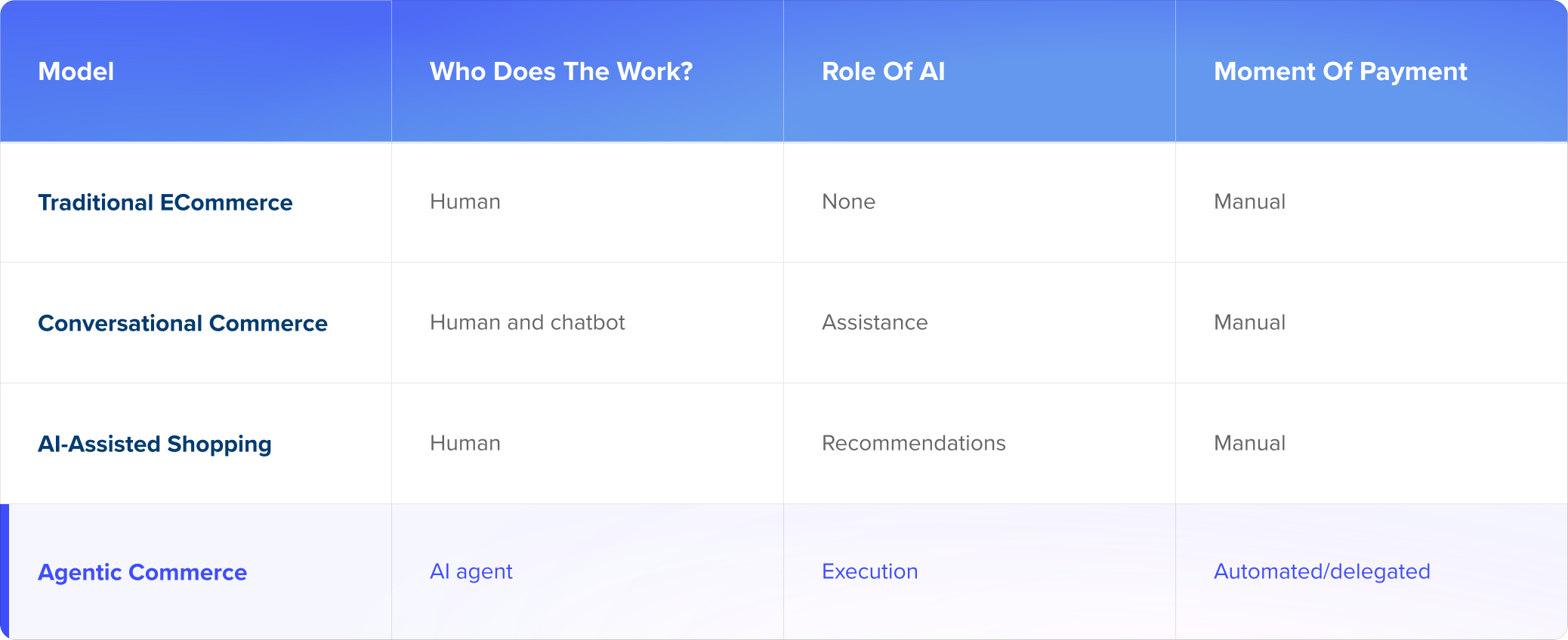
There are a few things that make agentic commerce possible, reasoning chief among them. Today’s AI models are sophisticated enough to parse complex instructions written in plain English, interpret what the user actually wants, and figure out what next steps they need to execute. For example, if a user were to ask for a winter coat that’s under $250 and ships before next Friday, the agent would work through their conditions one at a time, including price, shipping, and quality signals such as reviews.
AI agents are also able to handle when things go wrong. If, for example, one of the coats the agent shortlisted was back-ordered, it would choose another from another on its list, without the user ever having to intervene. AI agents designed to support agentic commerce use open standards such as the Model Context Protocol (MCP)1, Google’s A2A Protocol2, and the Agent Payments Protocol (AP2)3 to access systems, such as merchant’s catalogs, inventory systems, and the payment rails that finalize purchases.
What are different use cases for agentic commerce?
Use cases for agentic commerce are split between consumers and businesses and include personal shopping, subscription management, autonomous procurement, timing supplier payments, and managing foreign exchange (FX) risk exposure.
For consumers, personal shopping agents can handle anything from keeping your fridge stocked according to your household’s dietary needs and favorite brands to booking flights, hotels, and even airport transfers for upcoming trips. Managing subscription services is another good consumer use case: An AI agent might notice you haven’t used a streaming service in months and suggest, or even automatically make, changes such as downgrading your plan or canceling it, depending on the rules you gave it.
On the business side, autonomous procurement is the leading use case for agentic commerce. Agents can pull qualified suppliers from procurement systems, send out requests for quotes, and score responses based on criteria set by a company’s procurement team. In this example, the winning bid would automatically trigger an order and, if the deal falls within the limits leadership has approved, the agent would authorize the payment.
Treasury teams can use agentic commerce in a similar way to time supplier payments, balancing cash position against FX risk exposure and any early-payment discounts on offer. The most ambitious business use case for agentic commerce is contract negotiation; some companies are already testing setups in which the buyer’s AI negotiates terms directly with the seller’s AI before either side’s teams sign off.
How does agentic commerce work?
Agentic commerce works by handing the buying process over to an AI agent that takes it from a user’s initial brief through to delivery and any follow-up needed
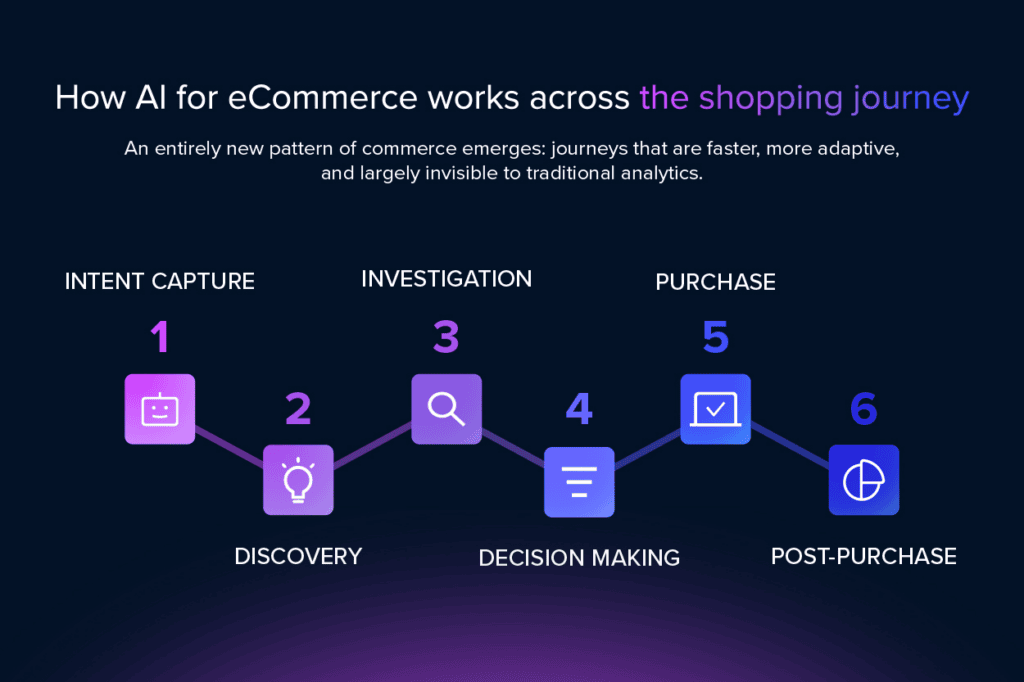
- Intent capture: The user tells the agent what to buy. Their instructions can be either specific or open-ended. If the instructions are open-ended, the agent asks follow-up questions to fill in missing details.
- Discovery: The agent searches across merchant catalogs, marketplaces, review sites, and product feeds and presents the user with a curated shortlist.
- Evaluation: The agent evaluates options on the shortlist against the user’s rules and makes a recommendation. The user can further refine the search at this stage by introducing additional parameters.
- Decision and authorization: The agent either checks in with the user before buying or proceeds on its own within pre-approved limits. Standing authorization covers routine purchases such as groceries, while bigger or unusual purchases require explicit approval.
- Purchase: With the user’s permission, the agent initiates an agentic payment. The agent may do so right away, or wait until certain conditions are met, such as a price drop. Although the agent technically makes the purchase, the user is still responsible for it. purchase.
- Post-purchase: The agent tracks the order through delivery. If something goes wrong, the agent steps in, either following the user’s preset rules or consulting them for a quick decision.
This entire process is powered by a few key technologies:
- Reasoning models let the agent think through open-ended requests. They’re the same kind of large language models (LLMs) behind tools such as ChatGPT, applied to a specific job: turning a goal into a plan, and adjusting that plan as new information comes in.
- Tool use refers to an AI model’s ability to call external software functions to complete a task. When an agent needs to search a product’s price, search a catalog, or submit an order, it calls a tool that handles that specific task and returns a result.
- Open standards such as MCP, A2A, and AP2 keep tool use from requiring a custom integration for every connection between an agent and an outside system.
What’s the difference between agentic commerce and agentic payments?
Agentic commerce refers to the full buying journey executed by an AI agent, while agentic payments refer specifically to the step in that process where the agent makes a purchase using pre-authorized credentials. Agentic commerce creates demand, while agentic payments capture revenue.
Agentic commerce is a broad category that encompasses everything an AI agent does when acting as a buyer, including:
- Gathering information from a user
- Searching for products
- Comparing products against the user’s criteria
- Deciding which product to purchase
- Completing the transaction
- Tracking delivery
- Making returns
The agent’s job spans the entire buying process, from start to finish. Agentic payments come into play at a specific part of the process: completing the transaction.
When the agent is ready to pay, it submits the payment using a mandate pre-authorized by the user. This mandate is a record that specifies what the agent can buy, how much it can spend, and any other conditions the user has set. The agent presents tokenized credentials, such as a tokenized card, rather than the user’s underlying payment details, which keeps the user’s actual card information out of the agent’s hands. From there, the payment moves through payments infrastructure the same way as any other transaction does; it’s authorized, routed, screened for fraud, and settled with the merchant.
The relationship between agentic commerce and agentic payments is one of scope. An AI agent compiling a list of items within a user’s budget is engaging in agentic commerce, as is an agent scanning reviews to determine which to purchase. Only the moment when the agent draws on its mandate to move money qualifies as an agentic payment.
Both agentic commerce and agentic payments raise important considerations for merchants. For agentic commerce, merchants must figure out how to make their products show up when an agent is searching, and how to present information in a way an agent can read and act on. For agentic payments, merchants must use payments infrastructure capable of handling transactions with no human at the keyboard, particularly for fraud and authentication.
Why is payments processing important for agentic commerce?
Payments processing is important for agentic commerce because the payments infrastructure determines whether agent-initiated transactions succeed, fail, or are declined, which makes it a critical control point. In an agentic world, authentication has to verify a delegated permission rather than a person, fraud systems have to model agent behavior, and routing has to happen at machine speed across multiple rails. Without payment processing built for these conditions, an agent can pick the right product, build the right cart, and submit the right transaction, only to have authorization fail.
How do agentic payments change the role of checkout?
Agentic payments makes checkout a background process where payment decisions may happen instantly or conditionally, such as when a price drops or an item comes back in stock. This requires payment systems that can make fast, deterministic decisions, and support machine‑to‑machine interactions, rather than relying solely on human confirmation. With agentic payments, checkout becomes invisible infrastructure that must operate reliably without user input.
Why is payments orchestration important for agentic commerce?
Payments orchestration helps manage the complexity that comes with agent-driven transactions by coordinating routing, fraud checks, authorization logic, and settlement from a centralized layer. This enables merchants to support agentic payments while maintaining control, consistency, and performance across channels. In an agentic world, orchestration is how merchants maintain control.

What do payment systems need to handle agentic transactions?
Payment systems need to be able to verify pre-authorized mandates from users, and everything downstream of that verification has to adapt to a buyer that isn’t a person. Enterprises preparing for agentic commerce will need revisit their payment stack in the following ways:
- Fraud detection: Fraud models watch for behavioral signals that might suggest a transaction is illegitimate, such as unusually fast checkout and billing and shipping mismatches. Most of these signals are trained on human behavior, which means AI agents are more likely to trip them when they go to make purchases.
- This introduces two types of risk: legitimate transactions being blocked as fraud, and bad actors using AI agents (or pretending to) to push transactions through systems that have yet to adapt to agentic commerce. In this new world, where AI-driven shopping is likely to become the norm, fraud detection needs to use new models trained on what legitimate agent behavior looks like, and on the patterns that signal an agent is being misused or impersonated.
- Routing: Agents can transact at higher volumes than humans and have access to more payment options. Each rail has different cost, speed, and reliability characteristics, and an agent making a lot of purchases needs to be able to pick the right one for each transaction. Static, rule-based routing, which is set up to send everything through one or two preferred rails, won’t hold up to the volume or the variety AI agents will produce.
- Compliance: Know Your Customer (KYC), anti-money laundering (AML), and consumer protection obligations don’t go away just because the buyer is an AI. With that said, these frameworks were written with a human counterpart in mind. Adapting them to agentic commerce transactions raises questions without settled answers (yet). Questions such as how to apply identity verification when the entity initiating the payment is an agent acting for an already-verified user, or how to handle disclosure requirements when the buyer never sees a checkout screen.
- Payments infrastructure: needs to capture the right information about both the agent and the user it represents, apply the relevant checks against both, and stay flexible as regulatory guidance catches up to the new transaction patterns.
- Auditability: If a user disputes a charge, or a regulator asks how a transaction was approved, enterprises need to be prepared to present an audit trail that shows what the user authorized, what the agent did with that authorization, and how the infrastructure responded at each step. That requires a tamper-resistant record across all three layers — and the requirement gets stricter as agentic transaction volumes grow and edge cases become more common.
- Multi-rail flexibility: Agents will pick whichever rail fits each transaction best, but they can only do that if those rails are available to them. Payments infrastructure needs to expose cards, real-time payments, account-to-account, stablecoins, and other options through a single integration, so an agent isn’t limited to whichever rail the merchant happens to support best.

What are the risks and challenges associated with agentic commerce?
The biggest risks in agentic commerce include agent identity fraud, unclear accountability, evolving regulatory requirements, and challenges in maintaining user trust. Let’s look at these in detail:
- Agent identity fraud: How can merchants spot the difference between transactions from legitimate agents and fraudulent ones? Bad actors can deploy their own AI agents — or impersonate someone else’s — to push fraudulent transactions through at speeds that would overwhelm a human review queue. Verifying agent identity is a new problem for fraud teams, and the tools to do it well are still in the works.
- Accountability: If an agent buys the wrong thing, or buys something the user didn’t actually want, who’s responsible? Is it the user, who set up the permission; the agent’s developer, whose model made the decision; or the merchant, who accepted the transaction? Existing consumer protection laws assume a human made the purchase and don’t map cleanly to a world where AI is acting on behalf of shoppers. Until courts and regulators settle this question, enterprises taking agentic transactions will operate without a clear liability framework.
- Consumer trust: Agentic commerce only works if users are willing to delegate purchasing decisions to an AI. That’s a higher bar than it might seem. Users expect clear visibility into what their agents are doing, easy ways to set and adjust spending limits, and confidence that they can override or revoke agents’ permissions at any time. Designing for that kind of trust — and earning it consistently — is its own challenge, separate from the technical work of making AI agents function.
- Regulatory uncertainty: Most payment regulations were written with human-initiated transactions in mind. Strong customer authentication rules under PSD2, for example, assume a person is present to authenticate; KYC rules assume the buyer is the person being verified. Regulators are aware of agentic commerce and have begun exploring how existing frameworks should apply, but settled guidance is some way off. Enterprises moving early will need to make their best interpretation of current rules and stay ready to adjust as new guidance arrives.
Is agentic commerce safe?
Agentic commerce is safe when both sides of the transaction take the appropriate precautions, though users need to be wary of misconfigured agents or overly broad permissions, both of which can lead to unwanted purchases.
The protection is setting clear spending limits, reviewing agent activity, and revoking permissions when something looks off. Merchants have to guard against fraudulent agents impersonating legitimate ones or pushing bad transactions through at machine speed, which calls for fraud detection tuned to agent behavior and reliable verification of agent identity on each transaction.
How does fraud prevention work when an AI agent is buying?
When an AI agent is buying, fraud prevention moves away from device- and session-level signals toward verifying that agent’s identity, its mandate, and whether its behavior fits the pattern of legitimate agentic activity. Payments orchestration platforms can help apply the right fraud logic dynamically, ensuring legitimate AI agents aren’t mistaken for malicious bots.
Does agentic commerce reduce merchant control?
Agentic commerce doesn’t reduce merchant control. While AI agents may execute actions, merchants still define pricing, policies, fulfillment rules, and payments acceptance. The difference is that decisions must be machine‑readable and consistently enforced. Orchestration helps merchants retain control by ensuring agent‑initiated transactions follow the same — or stricter — rules as human‑initiated ones.

Which industries will agentic commerce affect the most?
Agentic commerce will benefit the fashion, home and lifestyle, food and grocery, travel, and B2B procurement industries in the following ways:
- Fashion: Agents curate outfits to a user’s style and budget, manage returns, and handle size selection across brands with different sizing standards
- Home and lifestyle: Agents source furniture and décor against a stated budget and aesthetic, coordinating across multiple retailers to assemble a complete room.
- Food and grocery: Agents handle restocking against household rules — dietary restrictions, brand preferences, substitution logic — and manage delivery logistics.
- Travel: Agents plan full itineraries, monitor prices for booked trips, and rebook when conditions change.
- B2B procurement: Agents automate replenishment for repeat-buy categories like office supplies and MRO parts, drawing on historical purchasing patterns to keep inventory at the right levels.
The common thread across each of these industries is that buying decisions can be reduced to a clear set of rules an AI agent can act on. Industries that depend on judgment, expertise, or human relationship — luxury retail, complex financial advice, healthcare — may see slower adoption.
What does the future of agentic commerce look like?
The future of agentic commerce points to rapid adoption, fundamental changes in how merchants design their digital storefronts, and a reshuffling of which payment rails have the highest volumes. Here are a few trends we’re keeping an eye on:
- Adoption is moving faster than most categories. McKinsey4 reports that 44 percent of users already prefer AI-powered search to traditional search, which is a useful proxy for how quickly people are getting comfortable handling tasks over to AI. Agentic commerce is the next step on that curve. Consumer and B2B adoption are both accelerating, with B2B moving faster in areas where use cases have clear ROI, such as procurement, supplier payments, and treasury operations.
- Agent-ready merchant sites will become a competitive necessity. Merchants today optimize their sites for human shoppers, including visual hierarchy, persuasive copy, smooth checkout flows. AI agents read sites differently. They prefer structured product data, clear pricing and availability signals, and APIs they can call directly. Merchants who don’t expose their catalog and checkout in formats agents can work with will start losing transactions to merchants who do, the same way merchants who didn’t optimize for mobile lost share to ones who did over a decade ago.
- Agentic transactions will shape which rails grow fastest. Card networks will continue to handle a large share of agentic transactions, but the rails that fit agent behavior best — real-time payments, account-to-account, and stablecoins — are positioned to grow disproportionately as agentic volume grows.
Real-time payments give agents the speed they’re built for. Account-to-account flows reduce per-transaction costs at the volumes agents will produce. Stablecoins handle cross-border payments without the friction of currency conversion, which matters for B2B agents transacting internationally. The rails that suit agentic transactions stand to gain the most as agentic transactions become a larger share of total volume.
How can businesses prepare for agentic commerce?
Businesses can prepare for agentic commerce by making their digital presence readable to AI agents, upgrading their payments stack to handle agent-initiated transactions, and identifying where agents can add value inside their own operations. Each of these takes some work:
- Making their business agent-readable: Agents work best with structured product data, consistent attributes, clear pricing and availability signals, and APIs they can call directly. Merchants whose product information is locked inside visual layouts will lose share to merchants who expose it in formats agents can read.
- Preparing their payment stack: Agent-initiated transactions put pressure on authentication, fraud detection, routing, and compliance in the ways covered earlier in this guide. Businesses that want to accept agentic payments reliably will need their payment infrastructure ready for them before the volume arrives, not after.
- Figuring out where agents fit inside the business itself: B2B applications are moving faster than the consumer side in some categories, and businesses that pilot internally will get a clearer sense of where agents add value before competitors do.
Can existing payment systems support agentic commerce?
Existing payment systems can support agentic commerce, but most need additional layers to handle flexible routing, real-time decisioning, and the ability to interpret delegated authorization. Merchants increasingly look to orchestration layers to adapt existing payments infrastructure to these new interaction patterns without rebuilding everything from scratch.
Is your payments strategy ready for agentic commerce?
AI agents are reshaping commerce from product discovery to payment. Evaluate your readiness and uncover the gaps in your payment infrastructure.
How does ACI Worldwide support agentic commerce?
ACI Worldwide is actively preparing merchants for the agentic commerce era, with capabilities built specifically for how AI agents interact:
- Fraud detection for agent behavior: ACI’s fraud models are engineered for agent-specific signals, drawing a clear line between trustworthy agents acting on legitimate delegated permissions and malicious bots attempting to push fraudulent transactions through. As agent volumes grow and behavioral patterns become more varied, the models continue to evolve alongside them.
- Payment execution built for machine-to-machine flows: ACI supports the emerging agentic payment protocols that let agents transact securely with merchant systems and orchestrates those transactions across the full path while keeping the flow normalized and consistent on the merchant side. Authorization, compliance, and governance workflows are adapted for agent-initiated transactions, so merchants stay insulated from the protocol and regulatory changes still happening across the space.
- Integration with existing infrastructure: Agent-initiated payments integrate seamlessly into the payment, fraud, and settlement infrastructure merchants already have in place, which means enabling agentic commerce doesn’t require a parallel stack. Enterprise-grade security protects the high-automation, high-throughput environments agents create, and the same controls extend across the full transaction flow.
- Pilots, standards, and continuous improvement: ACI is running global pilots with early adopters to refine agent-friendly workflows and establish best practices, and continues to update its capabilities as networks, acquirers, and standards bodies define new rules for agent-originated transactions.
Article Sources
Analysis draws on reports and statements from central banks and international bodies (FSB, BIS, Bank of England, etc.), which document the scale, challenges, and initiatives in cross-border payments.
Related resources

Cards aren’t disappearing—They’re getting smarter
A practical guide for banks on why cards remain essential and how unified, multi‑rail infrastructure will shape the next decade of payments.

Payments in transition: Leadership in an era of transformation
Money powers the global economy, but the systems behind it are in rapid transition. This report is designed to guide you through that change,

Card modernization as a profit-and-growth strategy
How modern card platforms turn scale and change into economic leverage

Is your card platform holding back growth? Legacy vs. modern explained
What does “modernization” really mean in cards, and why does it matter for profit and growth?

2026 Fraud trends banks must prepare for
As banks navigate 2026, fraud continues to escalate at a pace that challenges even the most prepared institutions. Preliminary industry analyses indicate that consumer fraud losses are experiencing year‑on‑year growth at roughly 20%.