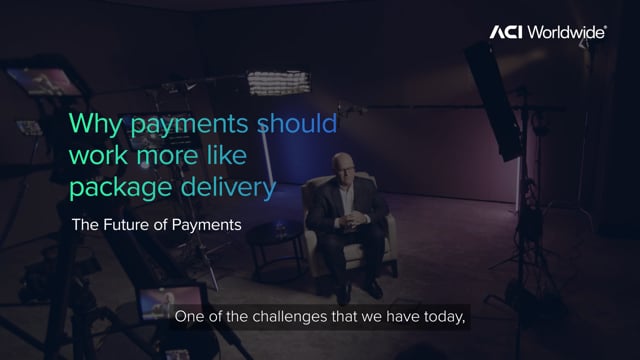
When you order something on Amazon, you don’t tell the courier which van to use or which route to take. You just say where it’s going and how fast you want it. Simple.
So why, asks President and CEO of ACI Worldwide Tom Warsop, does sending money still feel nothing like that?
“If I want to send you money today, it is my responsibility to decide how I do that,” Warsop says. “I have to figure out the fees, the rails, the routing. That shouldn’t be the way it is.”
His fix is straightforward: A customer should only ever need to supply three things: how much, to whom, how fast—and let the infrastructure sort out the rest. “That’s easy to say, not all that easy to do.”
“It should work like shipping at Amazon. I should just be able to give three pieces of information. How much. To whom. How fast.”
— Tom Warsop, President & CEO, ACI Worldwide
The plumbing wasn’t built for this
Part of the problem is historical. For more than a century, Warsop argued at ACI’s recent Payments Unleashed event in London, every new payment type got the same treatment from banks: a new department, new staff, a new VP, bolted onto everything that came before. “Nothing’s ever gone away,” he said. “So it becomes more and more complicated.”
That legacy is exactly why routing money efficiently is still, in his words, “very challenging”: Most banks simply can’t tell you which path will move money at the lowest cost. It’s also exactly the kind of problem AI is suited to solve. Train a model on the fee structures, rules, and rails across the ecosystem, Warsop says, and suddenly a task that used to require custom-coded rules for every scenario becomes near-instant: Ask for the cheapest way to move £1,000, and get an answer.

Where stablecoins actually fit
Stablecoins and tokenized deposits are the newest instruments on the rails, and Warsop pushes back hard on the idea that they’re competing with each other, or with anything that came before.
History doesn’t support the “cannibalization” story, he argues. New payment types don’t replace old ones, with checks being the rare exception. More often, they add capacity as the overall market for payments keeps growing.
Warsop sees stablecoins and tokenized deposits as specialists, each suited to different jobs. Stablecoins meet certain use cases extremely well, but the issuer generally needs to hold reserves against every token in circulation. That limit doesn’t apply to tokenized deposits, which give banks more flexibility and more revenue potential while delivering much of the same value. That is why he expects banks to lean harder into them. His goal is interoperability: getting these instruments to work together so payment users can choose the vehicle that fits.
Trust is the constraint on everything
Fraud is accelerating: Warsop describes fraudsters as smart and well-funded, arming themselves with new tools daily.
“Consumers don’t have the trust in AI yet. We’ll get there.”
— Tom Warsop
ACI’s own research backs that up: Only 18% of UK consumers trust AI to act in their best financial interest as a shopping agent, and just 15% trust it to handle problems when something goes wrong.
Whatever the technology, the test is the same: Does money move simply and securely, without people having to think about how?
Payments are changing fast. Are you keeping up?
Get straight answers from ACI leaders on AI, stablecoins, payments routing, and fraud in The Future of Payments video series. Practical takes, no jargon, and each video takes only minutes.