Ask most payment executives whether AI is transforming their industry, and you’ll get an enthusiastic yes, usually followed by a roadmap. Erich Litch’s answer is different. “It’s pretty transformational in a lot of different industries,” he says. “But I don’t think it’s going to transform payments.”
“I don’t think AI is going to transform payments.”
— Erich Litch, General Manager of Payment Software, ACI Worldwide
That’s not skepticism about the technology. It’s a read on the industry’s history. Payments has absorbed major shifts before: the internet in the late ’90s, mobile after 2008. Both were called transformational at the time. Both were, in the sense that the industry harnessed them and moved forward. Neither rewrote what payments fundamentally is.
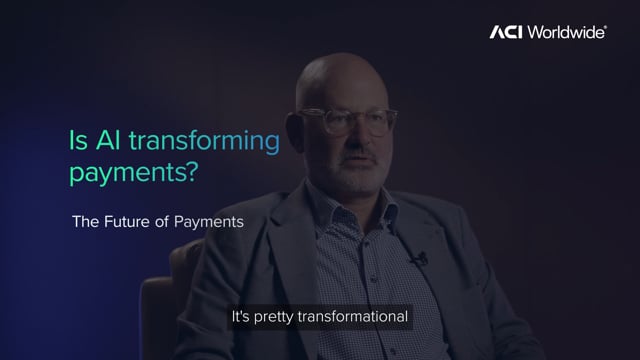
AI is just the latest version of that pattern, in Litch’s view—another powerful technology the industry will put to use. The real question isn’t whether it changes everything; it’s which institutions are actually built to use it.
Where AI is real, and where it isn’t
Litch separates what’s actually working from what’s just talk.
Fraud detection is real. It’s one area where AI isn’t just a pitch or a pilot—it’s been running in live systems for years, actually catching fraud, with results you can measure: fewer fraudulent transactions getting through, fewer false declines.
Internal productivity is real, too, if less visible: faster coding, prototyping, and requirements work that shows up as cycle time rather than a line on a product roadmap.
Everything else, in Litch’s view, is mostly still hype, agentic commerce chief among them. Adoption is low, and the gap between media coverage and actual usage is wide. That’s not a claim that agentic commerce won’t matter eventually. It’s a warning against treating a future channel as a present one.
The uncomfortable diagnosis
“…probably the vast majority of companies are not ready to really harness the full power of AI,” he says, not for lack of ambition or vendors, but because “they have a lot of legacy technology… that are not able to expose data in very easy ways.”

So AI gets bolted onto old infrastructure. The result is exactly what you’d expect: demos that work, pilots that stall, value that never compounds.
Litch’s conclusion is direct: Modernization has to come before AI delivers its full value, not alongside it. Most AI in payment strategies starts with use cases and treats the underlying platform as a footnote. He’d flip that order entirely. Two questions matter more than any AI maturity score:
- How quickly can a new application get clean, governed access to your payments data?
- Can your core systems act on a modern capability directly, or do you have to wrap them first?
If the honest answers are uncomfortable, the AI roadmap is optimistic fiction, and the modernization roadmap is the real AI roadmap.
The card isn’t dead. It just changes shape.
Litch pushes back just as hard on another industry cliché: that the card is dying.
The mistake, he argues, is confusing the object with the product. Plastic is just the current form. The underlying product has already moved into the phone with Apple Pay, and it’ll keep moving, into biometrics, into whatever comes next. Underneath all of it, the card rails still handle enormous volume with mature dispute and liability frameworks that have absorbed every form-factor shift so far.
Treating a new form factor as a rail replacement, in his view, is how companies end up making expensive bets against infrastructure that isn’t actually going anywhere.
Your next customer is still a person
Finally, Litch takes on the idea that the next payments customer might not be human at all.
His reasoning comes down to money: People have it, AI doesn’t.
What changes isn’t who the customer is. It’s how institutions reach them. The new requirement is verification: confirming the link between an AI agent acting on someone’s behalf and the accountable person behind it. Get that link wrong, Litch warns, and institutions face a hard choice: block a growing channel or accept liability they can’t defend.
What actually separates winners from losers
Everyone will adopt AI. That was never really the question. What separates the companies that benefit from it and the companies that don’t is what’s underneath: whether the platform can actually use the technology or just carry it as another feature bolted onto old infrastructure.
Payments are changing fast. Are you keeping up?
Get straight answers from ACI leaders on AI, stablecoins, payments routing, and fraud in The Future of Payments video series. Practical takes, no jargon, and each video takes only minutes.