On this page
Buy online, collect in-store. Order in-store, ship home. Purchase on the app, while in-store, return by mail three weeks later. None of this is new in fashion retail. It’s the shape of a fashion journey and what omnichannel retailing actually looks like from the customer’s side.
The infrastructure underneath it? Frequently still organized around a channel model that shoppers left behind years ago. Closing that gap is what the trends below are really about: eight shifts across payments, stores, apps, returns, personalization, and AI, each pointing at the same problem from a different direction.
Omnichannel shopping is the majority behavior, not a segment
New ACI Worldwide research, fielded by YouGov among 3,000 US and UK fashion and sportswear shoppers in June 2026, puts hard numbers on this trend. The report uses the term hybrid deliberately. Omnichannel commerce and unified commerce both describe what the retailer builds or aims to build. Hybrid describes what the customer actually does: one purchase journey that crosses more than one channel, assembled on the fly.
The distribution looks like this: Home delivery remains the volume driver, with 68% of shoppers buying online for home delivery. But more than a third (35%) buy online and collect in-store, 28% buy online and return in-store, 20% buy in-store and return by mail or courier, 18% place an order in-store for home delivery or store collection, and 15% use a retailer app while standing inside the shop.
Women lead hybrid behavior: Click and collect is at 41% vs. 28% of men, in-store returns of online orders at 35% vs. 21% of men. Sportswear shoppers go even further on hybrid behavior: They use retailer apps in-store at 21% vs. 15% overall and return online purchases in-store at 34% against 28%.
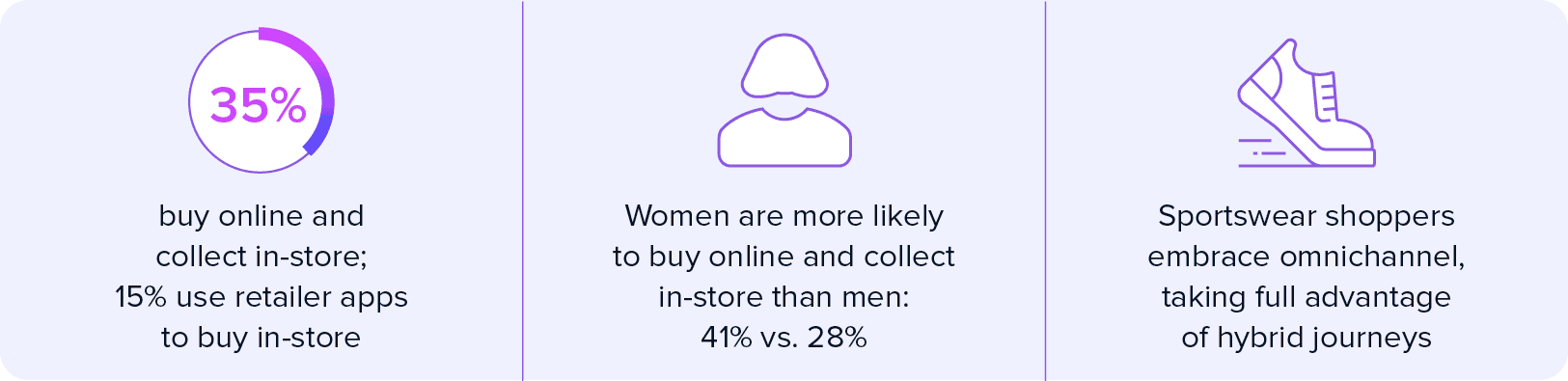
Geography is the biggest variable. Click and collect runs at 41% in the UK compared to 21% in the US, the widest transatlantic gap in the whole channel dataset. In-store returns of online purchases sit much closer, at 29% in the UK and 26% in the US.
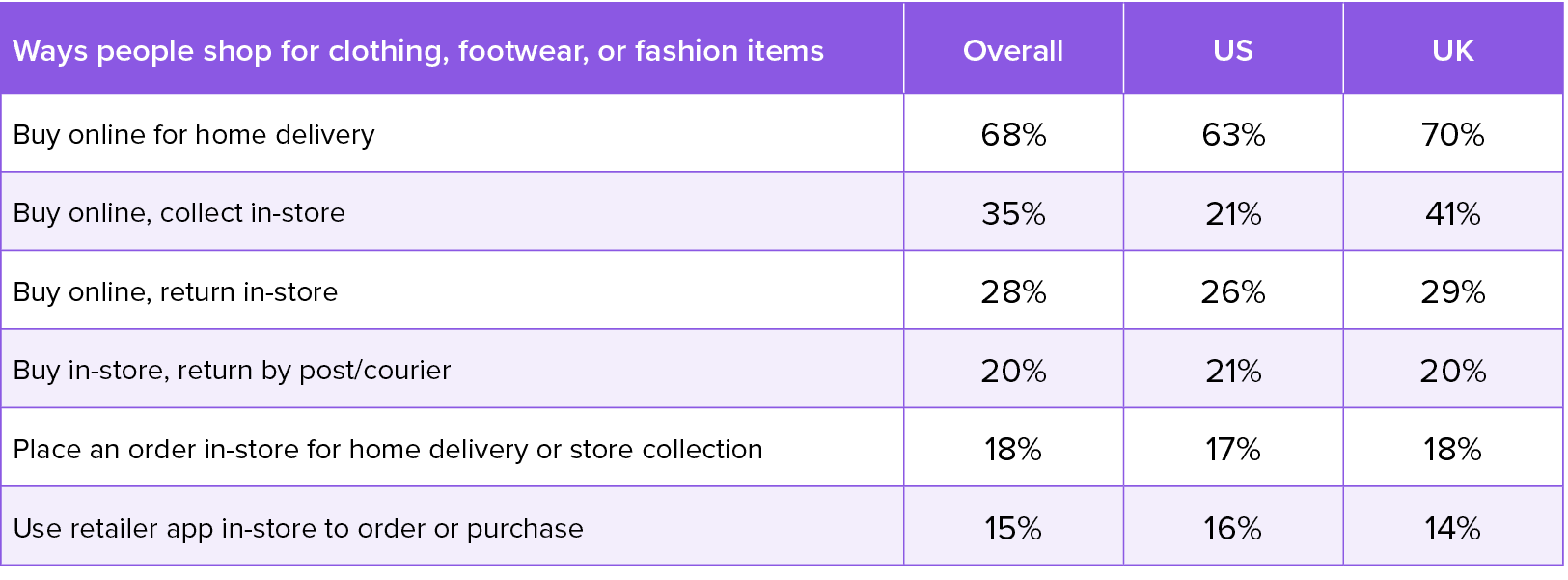
Because respondents could select multiple choices, these aren’t six separate populations. They’re overlapping habits. The average fashion customer isn’t an online shopper or a store shopper. They are both, often within the same transaction. Supporting that behavior touches inventory, payments, store operations, app design, returns, and now AI agents.
Unified commerce replaces siloed channels
While most leading retailers deploy multi-channel strategies, the reality is that many fashion retailers still run eCommerce, retail, and mobile app as separate departments, with a data and operational divide still existing1.
Hybrid shoppers cut across channels, and that gap shows up in the customer’s experience as small, specific failures. The store can’t see the online order. The refund has to go back through the original channel, meaning a store can’t refund an online purchase. The card saved in the app has to be entered again on the website. Each is minor on its own, and collectively they’re the reason a hybrid journey converts worse than a single-channel one despite being worth more.
Unified commerce2 means one customer record, one view of inventory, and one set of payment credentials that every channel reads from and writes to, rather than three systems reconciling overnight. Retailers making that move are also finding they have to change how the channels are measured, because an eCommerce team incentivized on eCommerce revenue has no reason to fund a click-and-collect improvement that books as a store sale.
Payments orchestration becomes the conversion lever
This trend gets left off most lists, and it has the clearest revenue uplift attached.
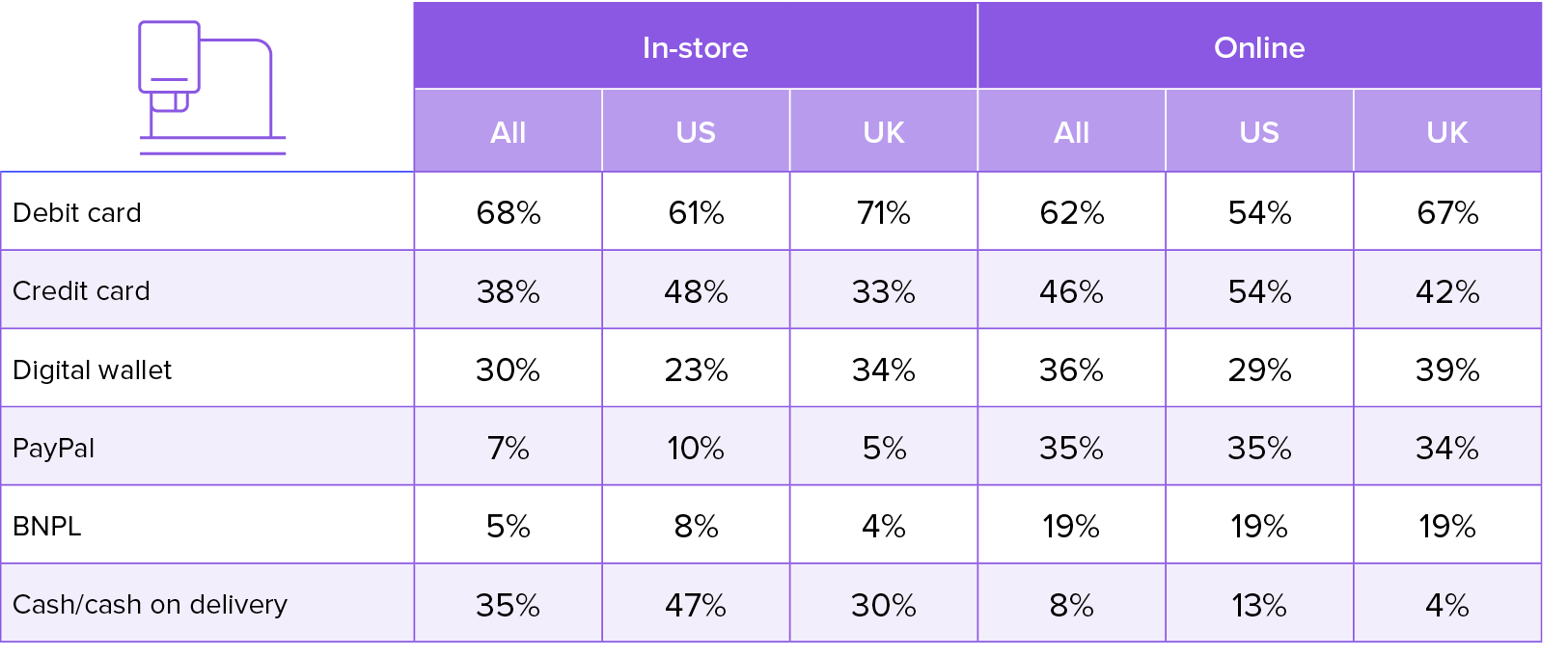
First, payment preferences don’t travel well. And preferences shift as much by channel as by country. For fashion purchases, debit cards lead in-store at 68% overall, but that’s 71% in the UK vs. 61% in the US, where 47% still pay cash in-store compared with 30% in the UK. Digital wallets hit 34% in the UK versus 23% in the US, and 51% of 18- to 24-year-olds prefer paying online with a wallet. Nearly one in five shoppers use buy now pay later (BNPL) online.
Miss the right method and the sale goes: 19% abandon when their preferred payment method isn’t available. When a payment fails, 39% give up entirely and 22% go straight to a competitor. Surprise costs at checkout are worse, sending 40% away.
Payment methods used for fashion purchases in-store, and online
Second, the part shoppers never see is where most optimization opportunity sits. ACI merchant data indicates that for large retailers, a 2–6% improvement in payment acceptance rates can translate into millions in recovered revenue.
AI moves faster behind the scenes
AI is already performing several tasks in fashion retail. Behind the scenes, it forecasts demand and positions inventory closer to where it will sell. It also screens transactions for fraud in real time, catching patterns a rule-based engine or a human would miss. In front of customers, it handles service inquiries.
In the customer’s hands, AI is still used for recommendations. According to ACI research, 35% of consumers see value in AI-driven price-drop alerts, and 35% in comparing prices across retailers. These are the trusted entry points into agentic commerce. Beyond that, interest drops sharply: 53% are unwilling to let AI make purchases on their behalf under any circumstances, and only 7% would allow an assistant to make purchases without their approval.
Openness isn’t evenly spread, and it maps onto hybrid channel behavior. The customers already moving fluidly between retail app, store, and web are the ones most ready to add an agent to that mix. More concretely, sportswear shoppers are the least resistant to AI: Rejection falls to 44% against 53% overall, while price-drop alerts (43% against 35%), price comparison (43% against 35%), and AI help with returns (24% against 17%) all run well ahead. Women show a similar pattern, with 38% rejecting AI shopping tools outright against 42% of men.
All the AI-assisted jobs run on the same foundation: accurate data. Forrester predicts3 a quarter of shoppers will use retail chatbots or autonomous agents for product discovery in 2026, and an agent checking availability has no tolerance for inventory drift. A human shopper forgives a stale stock figure and picks something else; an agent reads it as unavailable and moves to another retailer, losing the sale before anyone sees the product page.
Stores become experience and service hubs, not checkouts
The store’s role keeps shifting toward experience, fulfillment, returns, advice, and brand trust, with the transaction increasingly initiated elsewhere. More than a third of shoppers buy online and collect in-store, 28% buy online and return in-store, and 18% place an in-store order for home delivery or store collection. None of those began at the till.
The store is also a place where the app gets used. In the same ACI survey, 15% of shoppers use a retailer app while standing inside a shop, rising to 19% among 18- to 24-year-olds. What they want from retailer apps is practical: easier browsing at 34%, order tracking and returns at 33%, discounts and promotions at 32%.
That overlap between a physical visit and an open retailer app is where contactless technology earns its place. NFC tags in garment labels, fitting rooms, or store displays let a shopper tap a phone to pull up sizing, stock in other locations, styling content, or a loyalty offer, without hunting for a code or being asked to download anything. The interaction is short-range and deliberate, which makes it a clean signal of intent. That signal can trigger a discount redeemable in the app or online later, turning an in-store session that ended without a purchase into an identified customer and a personalized offer.
All of it rests on the same condition. A store absorbing the service half of a purchase that started online only works when associates and systems can see the order, the inventory, and the customer in real time. Without that, click-and-collect handoffs become manual reconstruction at the counter, and a tapped coupon becomes an offer the business can’t honor in a different channel.
Personalization is where younger shoppers are pulling the market
Personalization in fashion4 goes beyond recommendations to include customization, made-to-order services, and connected products, with shoppers increasingly expecting an item or an experience shaped around them rather than pulled off a rack.
As the ACI survey shows, another dimension of personalization in fashion is generational. Tailored product suggestions appeal to 25% of 18- to 24-year-olds against 11% of 55- to 65-year-olds, and outfit recommendations to 22% against 10%. Within retailer apps, the perceived benefit of personalization is nearly five times higher among the youngest group (19%) than the oldest (4%). The demand will likely steepen as younger shoppers gain spending power.
Another key issue is where personalization has to work. A customer’s real signals might be a fitting-room visit, a click-and-collect pickup, and an in-store return, none of which a recommendation engine reading web sessions can see. In a hybrid world, relevance depends on the whole journey, which puts personalization on the same foundation as everything else here: one source of truth for the customer, visible across every channel.
Social and promotions drive unplanned demand
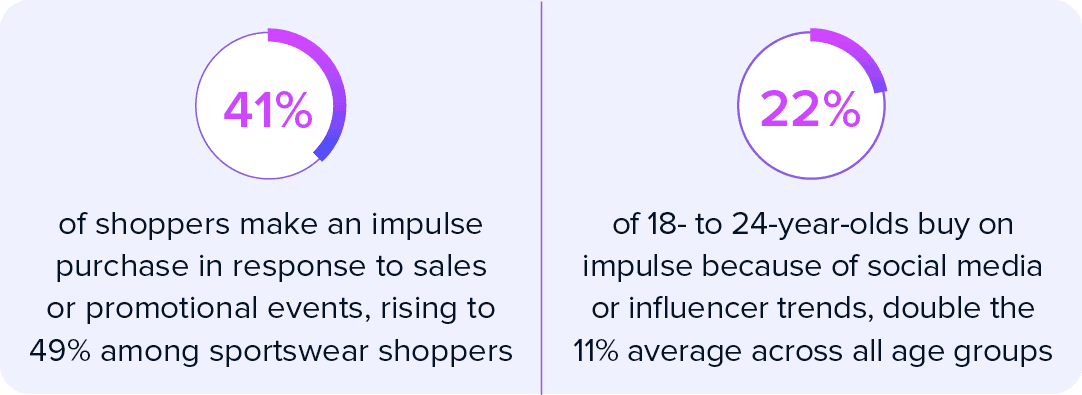
Social commerce accounts for roughly 15% of total eCommerce sales according to Statista Digital Market Insights5. The ACI data shows how that mirrors in behavior. Social media or influencer trends drive impulse purchases for 22% of 18- to 24-year-olds, double the 11% average. Limited-edition releases move 14% of that group versus 8% overall. Sales and promotional events remain the biggest impulse trigger for everyone at 41%, rising to 49% among sportswear shoppers.
Demand shaped this way is spiky and unseasonal, which puts real pressure on payments and fulfillment infrastructure to scale instantly during flash sales and viral moments.
The return becomes a cross-channel service moment
Returns used to happen where the purchase did. Now they’re a channel decision of their own: 28% of shoppers buy online and return in-store, and 20% buy in-store and return by mail or courier.
That makes the return part of the hybrid journey, and shoppers treat it as a service they judge the brand on. Order tracking and returns is the second most-cited benefit of a retailer app, at 33%, and there’s early appetite for AI here, too: 17% want help managing returns or exchanges.
Operationally, a store refunding an online order needs to see the original transaction, the payment method, and the customer. When returns run on separate systems per channel, the flexibility shoppers value most is exactly where the brand breaks down.
The policy question is just as delicate. Stricter return rules would push 55% of shoppers to buy elsewhere, so tightening for everyone costs more than it saves. The emerging answer6 is segmentation rather than restriction. Machine-learning models applied at the account level let retailers protect liberal returns for profitable customers while limiting exposure to the accounts that consistently cost more than they contribute.
The future of omnichannel retailing rewards the brands most focused on customer experience
One pattern runs through all trends. The customers adopting omnichannel shopping fastest are the ones with the least patience when it breaks. Women lead every blended journey and are also the most likely to walk: 46% abandon over a surprise cost at checkout against 35% of men, and 22% abandon the cart if their preferred payment method isn’t available vs. 15% of men. Younger shoppers show a similar profile. Optimizing for the average shopper means underserving the ones who matter most. Any fashion brand’s omnichannel retail strategy has to start from that.
The eight shifts above come at that from different angles, but they resolve into one requirement: recognizing the same customer, their payment credentials, and their order history wherever they turn up. Get it right and click and collect, in-store returns, app checkout, and agent-led discovery all work from the same foundation.
Read the full fashion consumer trends research
The new rules of fashion and sportswear payments report is based on a YouGov survey of 3,000 US and UK shoppers, fielded in June 2026, commissioned by ACI Worldwide. Beyond the channel data used here, it covers payment preferences by market, channel, and age, checkout friction and payments failure recovery, attitudes toward returns and returns abuse, how ready consumers really are for agentic commerce, and much more.
FASHION CONSUMER TRENDS REPORT
The new rules of fashion and sportswear payments
How shopping behavior, payment experiences, and trust shape conversion and loyalty in fashion retail.
FAQs
What is the ACI Worldwide Fashion Consumer Trends Report based on?
It’s based on a survey of 3,000 adult fashion and sportswear shoppers across the US and UK, aged 18 to 65, and split evenly between men and women. YouGov fielded the survey online in June 2026 on behalf of ACI Worldwide.
What is omnichannel retailing?
Omnichannel retailing connects every channel a brand operates, including web, app, stores, and social, to the same customer, inventory, and payments data so shoppers can move between them seamlessly. It differs from multichannel retailing, where those channels exist but don’t share data.
What are the biggest omnichannel challenges for fashion brands?
Channel-siloed payment and order systems, inventory accuracy for click and collect, assuming one market’s behavior transfers to another.
What does hybrid shopping mean for fashion retailers?
Hybrid shopping describes a single customer journey that crosses more than one channel: buying online and collecting in-store, ordering in-store for home delivery, or using a retailer app while inside a shop. We say “hybrid” rather than “omnichannel” because omnichannel describes what the retailer builds, while hybrid describes what the customer does with it. A brand can operate every channel and still fail the hybrid journey. Meeting it means recognizing the same customer and their saved payment and order data across every touchpoint, rather than treating each channel as a separate system.
How popular is BOPIS in fashion, and does it differ by country?
Click and collect is used by 41% of UK fashion shoppers compared with 21% in the US, the widest transatlantic gap of any channel behavior in the ACI Retail Fashion Trends study.
Are omnichannel customers worth more?
Omnichannel customers spend more per order and have a higher lifetime value than single-channel buyers. Brands with strong omnichannel engagement retain about 89% of customers versus 33% for single channel strategies.
What does the future of fashion retail look like?
It’s less like a set of channels and more like a single service that customers access through the nearest channel, with AI agents increasingly involved in the discovery process. The differentiator shifts from having channels to connecting them. This requires accurate inventory data, preferred payment methods, and recognition of the customer at every touchpoint. This recognition supports hybrid journeys and enables personalization. With demand driven by promotions, drops, and social moments rather than seasons, the infrastructure must scale instantly through spikes.
Article Sources
- https://technovapartners.com/en/insights/omnichannel-retail-strategy-2026 ↩︎
- https://www.hotwax.co/blog/omnichannel-retail-in-2026-key-trends-and-predictions ↩︎
- https://www.forrester.com/blogs/2026-retail-predictions-a-flight-to-profitability/ ↩︎
- https://zatap.io/the-power-of-personalization-in-fashion/ ↩︎
- https://www.statista.com/statistics/1251145/social-commerce-share-worldwide/ ↩︎
- https://www.forrester.com/blogs/2026-retail-predictions-a-flight-to-profitability/ ↩︎

ACI Worldwide powers electronic payments for financial institutions, retailers and processors around the world with its broad and integrated suite of electronic payment software.