On this page
A customer finds a product on social media. They browse it in a mobile app. They buy it online. They pick up the order in a store. Later, they return it at a different location.
For today’s consumers, this is a normal omni-commerce shopping journey. For retailers, however, every handoff between channels introduces friction. Customer data becomes fragmented. Payments information sits in separate systems. Loyalty records are disconnected from transactions. Valuable context gets lost.
The result is an inconsistent cross-channel experience for customers and a significant source of missed revenue for retailers.
New research from ACI Worldwide and Retail Dive’s Studio, based on a survey of 102 payment leaders across larger retailers in the US and UK, reveals the importance of connected payments. What the findings show: Many organizations still struggle to deliver truly unified customer experiences across channels.
The message is clear: The next phase of retail growth is not simply about accepting more payment methods. It’s about creating connected, intelligent payment experiences that recognize customers everywhere they engage and enable seamless commerce across the entire omnichannel journey.
Commerce has changed. Customer expectations have changed with it.
Modern retail no longer operates through separate online and in-store experiences.
Consumers constantly move between digital and physical touchpoints. According to the research, 88% of retailers report increased cross-channel shopping, while 77% have seen growth in mobile-driven journeys. More than half (55%) report higher customer expectations for seamless experiences.
This evolution has created what many retailers describe as “blended commerce,” where customers expect every interaction across several channels to feel like part of a single ongoing relationship.
Looking ahead, 70% of retailers say rising customer expectations for seamless cross-channel experiences will have the greatest impact on their payments and customer experience strategy over the next 12 to 24 months.
That makes it the top factor by a wide margin, ahead of expansion into new channels or business models (40%), greater loyalty and personalization expectations (38%), and the need to roll out new experiences faster (37%).
Which of the following customer purchase and payment experiences are most important to your organization today?
Shoppers now move between brick-and-mortar stores, mobile apps, and websites, and they expect the same recognition and omnichannel payments experience at every step, whether they tap to pay with a contactless payment, check out online, or pay with an account-to-account bank transfer. In the era of omni-commerce, meeting that expectation is no longer a differentiator. It is the baseline.
Unfortunately, many businesses are still organized around channels rather than customers. The survey found that retailers most commonly fall short in:
- Consistency of experience across channels (46%)
- Recognizing customers across channels (40%)
- Relevant personalization and offers (33%)
- Returns, refunds, and exchanges (25%)
These challenges affect more than customer satisfaction. They directly influence conversion, retention, and lifetime value. When customers face friction between channels, they are more likely to abandon purchases. They may also quit loyalty programs and switch to competitors that offer smoother experiences.
Why payments have become a strategic growth driver
For years, retailers viewed payments primarily as a utility. The objective was simple: process transactions quickly, securely, and reliably. Today, what happens around the transaction is as important.
- Can the retailer recognize the customer before checkout?
- Can the system apply loyalty rewards automatically?
- Can the system easily recover failed payments?
- Can users access payment credentials securely regardless of channel?
- Can customer service teams instantly view payments history and transaction context?
- Can the retailer deploy new commerce experiences without redesigning the entire payments architecture?
The survey highlights a significant shift in thinking. Retailers increasingly view payments as an enabler of growth rather than a back-office function. Connected payments data supports customer experience, personalization, payment success rates, loyalty initiatives, and faster innovation.
The primary theme is, ‘Do I understand, recognize, and know my customer? How am I supporting them and how am I earning their loyalty?’ Retailers are just trying to make existing experiences work.”
Balaji Parthasarathy
Senior Director, Product, Merchant Omnichannel
ACI Worldwide
This is where an omnichannel payments platform and payments orchestration become strategically important. Rather than treating web, mobile, store, loyalty, and payment systems as separate areas, retailers can use a single, unified payment processing platform. This base supports consistent experiences across every customer interaction. That includes the in-store systems: Point-of-sale (POS) terminals should draw on the same customer, credential, and loyalty data as web and mobile checkout, rather than operating as a separate island.
The hidden revenue leak of disconnected systems
One key research finding is that many retailers admit there are major gaps in the customer experience they offer.
In fact, 69% describe their payment systems as capable or highly optimized, yet 98% still identify at least one meaningful gap in supporting blended commerce. This reveals that the customer journey is not yet optimized. The most frequently cited challenge is a lack of unified customer and payments data, reported by 57% of retailers. Other common issues include inconsistent payment experiences across channels (48%) and fragmented loyalty or identity systems (40%).
The impact extends into customer support. Only 28% of retailers say they can investigate and resolve a customer’s payments issue from a single, unified view. For everyone else, servicing customers often requires navigating multiple systems and piecing together information across channels.
These disconnects create hidden revenue leakage across the business. For example:
- Abandoned shopping journeys because of inconsistent checkout experiences
- Missed cross-sell and upsell opportunities
- Lower loyalty participation
- Reduced customer retention
- Slower rollout of new commerce initiatives
- More complex service and returns processes
What gaps exist within your organization when it comes to supporting blended commerce?
- 57% Lack of unified customer/payments data
- 48% Inconsistent payments experience across channels
- 40% Fragmented loyalty or identity systems
- 27% Operational complexity
- 25% Limited payment method availability
- 21% Difficulty building a business case
- 2% No gaps exist in our organization when it comes to supporting blended commerce
At scale, they can significantly impact revenue growth. This is why many retailers invest in omnichannel solutions that combine customer, transaction, loyalty, and identity data into one framework. Effective omnichannel processing ties authorization, routing, and recognition decisions to the same customer record, so payment channel sales across web, app, and store are no longer managed in silos.
Customer recognition is becoming a competitive advantage
Customer recognition has emerged as one of the most valuable capabilities in modern retail. More than 80% of retailers report some ability to recognize customers across channels, but only around one-third say they can do so consistently.
That gap represents a substantial opportunity. When a retailer consistently recognizes a customer, every interaction becomes more relevant. The business can:
- Remember preferred payment methods
- Apply loyalty benefits automatically
- Personalize offers more effectively
- Enable frictionless returns
- Continue conversations across channels
- Simplify customer service interactions
These capabilities transform disconnected transactions into connected relationships. The ability to identify customers through tokenized cards, stored credentials, mobile apps, loyalty accounts, and payment account references (PAR) creates a unified understanding of customer behavior across the entire omni-commerce channel ecosystem.
For retailers focused on growth and retention, customer recognition is no longer simply a convenience. It is becoming a core differentiator.
The foundation of modern multi-channel payments
As retailers evaluate investments in omnichannel payment solutions, it’s easy to focus on emerging technologies. The research suggests that the fundamentals matter more.
When respondents were asked which payment experiences are most important today, the leading priorities were:
- Stored payment credentials usable across web, app, and store (73%)
- Cross-channel refunds and exchanges (56%)
- Mobile checkout experiences (28%)
- Buy online, pick up in store capabilities (27%)
- Loyalty-linked payments (26%)
These are not flashy innovations. They are foundational capabilities that make omnichannel commerce work.
Successful multi-channel customer payment systems ensure that payment credentials, transaction history, loyalty information, and customer context travel with the shopper regardless of channel.
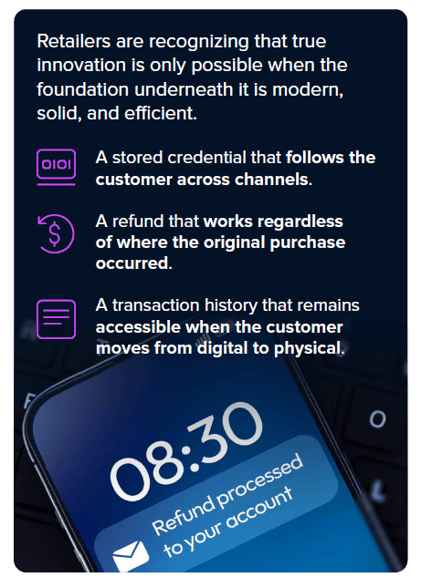
Without this omnichannel foundation, even the most sophisticated commerce initiatives often struggle to deliver meaningful business results.
Why AI makes connected payments even more important
Artificial intelligence is rapidly becoming part of retail strategy. The survey found that retailers expect AI to improve:
- Authorization and payment success rates (48%)
- Speed to launch new experiences (43%)
- Personalization (37%)
- Customer lifetime value measurement (34%)
- Customer experience overall (29%)
However, AI’s effectiveness depends largely on access to connected data. AI cannot generate context that does not exist. If payment records reside in one system, loyalty data in another, and customer profiles elsewhere, AI initiatives will struggle to deliver meaningful value. Connected payments provide the unified data layer AI requires. This is particularly important as agentic commerce evolves.
Future AI-driven shopping experiences may increasingly recommend products, build shopping carts, redeem loyalty rewards, select payment methods, and eventually complete transactions on behalf of consumers.
Retailers that invest in connected infrastructure today will be better positioned to compete in these emerging commerce models tomorrow.
Security must evolve alongside customer experience
While customer experience remains the primary driver of modernization, retailers cannot overlook security requirements. As commerce expands across channels, organizations must also protect payments across channels and maintain strong governance over customer data.
Modern omnichannel fraud prevention strategies should support both innovation and trust. This means enabling consistent experiences without introducing unnecessary risk.
The most effective omnichannel payment platform approaches combine customer recognition, payments orchestration, and fraud controls with centralized visibility across every interaction point.
In a world where customers engage through stores, websites, apps, marketplaces, social commerce, and AI-enabled channels, security in an omnichannel world must be designed into the customer journey from the start.
Connected payments will define the next era of retail growth
Retailers have spent years adding channels, payment methods, and technology. The next phase is about connecting and orchestrating what already exists. Retailers are increasingly focused on unifying customer, loyalty, and transaction data so every touchpoint can recognize the same shopper.
It’s no surprise that 70% of survey respondents say rising expectations for seamless cross-channel experiences will have the greatest impact on their payments and customer experience strategy over the next 12 to 24 months. Modern multi-channel payments are about more than processing transactions. They support stronger customer relationships, more effective personalization, faster innovation, and improved payments performance.
The good news is that many of the biggest opportunities are within retailers’ control. Shoppers have demonstrated that they want to move effortlessly between channels. Unified customer recognition and stored payment credentials that follow the shopper across channels lay the groundwork for more personalized experiences and can improve authorization rates. The same connected foundation is what AI-powered and agentic commerce experiences will depend on.
FAQs
What are connected payments?
Connected payments integrate payments, customer, loyalty, and transaction data across channels to create seamless customer experiences and provide retailers with a unified view of customer activity.
Why are omnichannel payment solutions important for retailers?
Omnichannel payment solutions help retailers deliver consistent experiences across stores, websites, mobile apps, marketplaces, and emerging channels while improving customer recognition, personalization, and operational efficiency.
What is multi-channel payments acceptance?
Multi-channel payments acceptance enables retailers to accept and manage payments consistently across multiple sales channels, including physical stores, eCommerce sites, mobile applications, and social commerce platforms.
How do connected payments improve revenue?
Connected payments improve revenue by reducing customer friction, increasing authorization rates, enabling personalized experiences, supporting loyalty engagement, and improving customer retention.
How does AI benefit from connected payments infrastructure?
AI performs best when customer, loyalty, and payments data are unified. Connected infrastructure provides the context AI needs to improve personalization, payments optimization, customer service, and future agentic commerce experiences.
One customer, every channel
Discover how retailers are connecting payments, loyalty, and customer data to deliver seamless cross-channel experiences and support future AI-powered commerce.

ACI Worldwide powers electronic payments for financial institutions, retailers and processors around the world with its broad and integrated suite of electronic payment software.