
Tip Sheet
8 tactics to improve omnichannel commerce in 2027
How connected payments turn every channel into one continuous customer journey, and what retailers can do to get there
Today’s customers move between channels without thinking about it. To them, browsing on a phone, buying in a store, and returning somewhere else is a single journey.
For retailers, delivering that unified commerce experience takes systems, data, and processes that recognize the same customer at every touchpoint.
70%
of retailers expect rising customer expectations for seamless cross-channel experiences to have the greatest impact on their payments and customer experience strategy over the next 12–24 months.
How big is the gap?
Your payments work on every channel. Your customers still get friction between them.
Most retailers rate their payment systems highly, and almost all of them still see a gap in unified commerce. Their systems work well in isolation but fall apart when a customer crosses from one channel to the next.
-
69%
describe their payment systems as capable or highly optimized
-
98%
identify at least one meaningful blended commerce gap
-
0%
say they consistently meet customer expectations
The gaps are most visible in two places:
- 46% say they fall short on consistency of experience across channels
- 40% on recognizing the customer across channels
How to fix it
Eight ways to close the gap and turn every channel into one journey
Each tactic comes with practical next steps you can act on now.
- 1Recognize the customer wherever they engage
- 2Unify payments across channels
- 3Make returns and refunds channel-agnostic
- 4Offer the same payments choice in store as online
- 5Protect payments on every channel
- 6Build infrastructure that scales through peak periods
- 7Integrate data for better insights
- 8Lay the groundwork for AI
Recognize the customer wherever they engage
Link every identifier to one person
Recognition goes well beyond a single customer ID. However a shopper shows up, a phone number, an email address, a tokenized card, or a payment account reference (PAR) are all aliases that should lead back to the same person.
Then act on it: remember a preferred payment method, honor a loyalty benefit, personalize an offer, resolve a return, continue a conversation that began in another channel.
34%
of retailers say they recognize the same customer consistently across most channels. Another 50% manage it only in some cases.
“The hardest place to recognize the customer is in the physical store.”
Dan Coates, Product Management Director, ACI Worldwide
Unify payments across channels
Let stored payment credentials follow the customer
When retailers were asked which purchase and payment experiences matter most today, the top answer was key for unified commerce.
73%
of retailers rank stored payment credentials usable across web, app, and store as the most important purchase and payments experience for their organization.
The mechanism that makes this work is cross-channel tokenization. Instead of holding sensitive card data in every channel, the system uses secure payment tokens or other credentials to stand in for it. That lets you recognize a returning customer at the till through a digital wallet, a card, or even a pay-by-bank payment method, even when their last purchase was made via a desktop.
Make returns and refunds channel-agnostic
Give customers the same flexibility in store that they get online
A customer browses online, buys at one store, and returns the item by post. Customers love that flexibility. However, retailers face operational challenges in supporting it. In-store return processes often rely on receipts or ID checks to reduce fraud while creating opportunities for exchanges and repeat purchases. Shipping an item back through the mail adds double-handling expenses—repackaging, re-entry into inventory—which erases the profit margin on local retail sales.
56%
of retailers rank cross-channel refunds, exchanges, and appeasements as the most important purchase and payments experience for their customers.
Retailers understand what’s holding them back. 34% say returns, refunds, exchanges, and appeasements would improve most with better-connected customer, payments, and loyalty data, while 25% say flexible, accurate returns are where they fall shortest of customer expectations today.
Offer the same payments choice in store as online
Don’t let customers’ options shrink at the door
Shoppers used to the flexibility of online checkout increasingly expect it at the till. Why should the same customer face two different sets of payment options depending on where they buy?
Retailers feel the pressure:
87%
of retailers report greater use of digital wallets and new payment methods over the last 12 months. 19% say payment method choice is where they fall shortest of customer expectations today.
Some payment options are easier to bring in store than others. Digital wallets are widely available at the till today. Buy now, pay later (BNPL) and account-to-account payments depend on what your terminals and providers support, such as virtual cards in a phone wallet, QR code scanning, or terminals with BNPL built in.
Protect payments on every channel
Payments security shouldn’t be compromised when the channel changes
Connected payments also means more customer data moves between systems: stored credentials, linked identifiers, shared payments, and loyalty history. This works well if customers trust the whole system, and that trust is only as strong as your weakest channel.
Build infrastructure that scales through peak periods
Retail sales increasingly peak without warning. Your services must keep up
Retailers generally feel good about reliability:
14%
say reliability and payment success rates are where they fall short of customer expectations.
The test is whether that holds when every channel hits peak volume together, and sometimes unexpectedly. Payment disruptions cost US retail and hospitality an estimated $44.4 billion in sales a year, and nearly two-thirds happen during peak hours.
Integrate data for better insights
Payments data is where fragmentation shows up first
The biggest barrier to blended commerce is not a missing channel. It is data that lives in separate places, so no one can see the whole customer journey.
57%
of retailers cite a lack of unified customer and payments data as a gap in supporting blended commerce. Another 40% point to fragmented loyalty or identity systems.
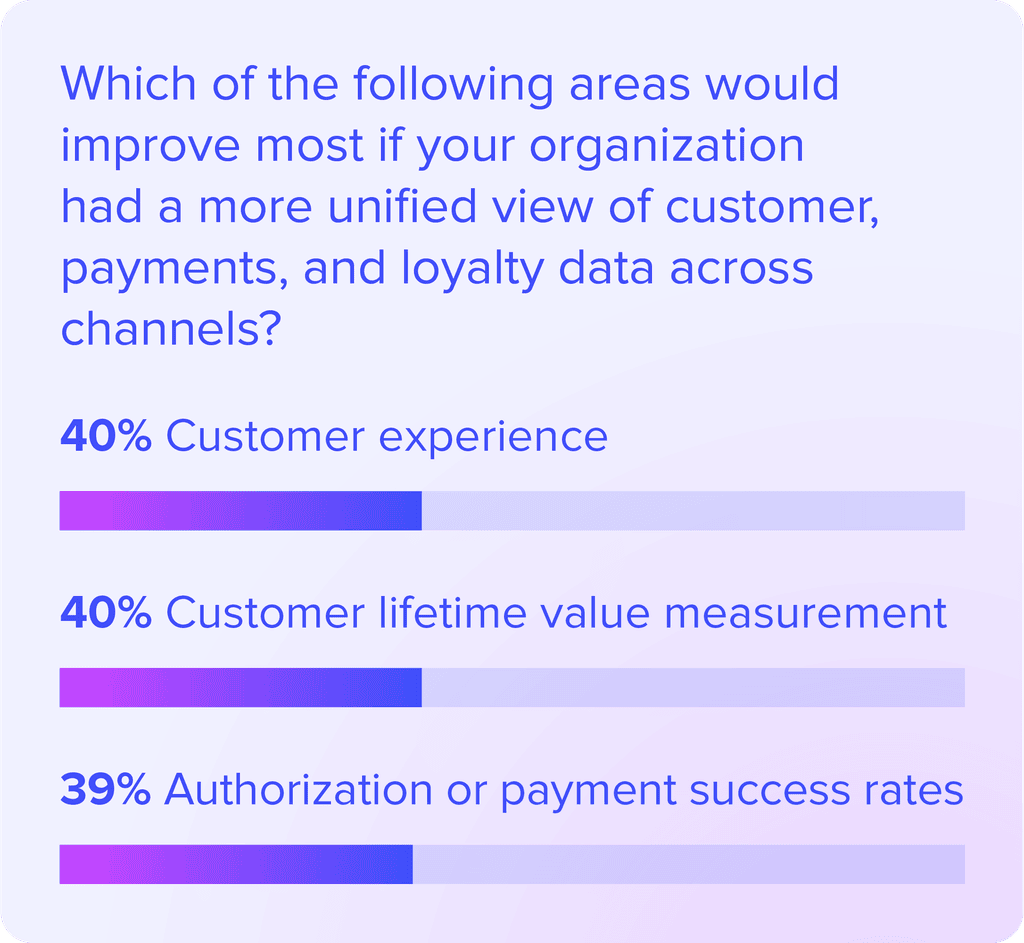
Connected data delivers value where customers notice it most. Retailers expect a unified view to improve customer experience (40%), customer lifetime value measurement (40%), and authorization or payment success rates (39%). By contrast, only 28% can easily investigate and resolve a customer payment issue through a connected view today. For everyone else, even a routine issue means moving between systems or piecing information together by hand.
Lay the groundwork for AI
AI can’t invent context that doesn’t exist.
“AI is only as smart as the data you feed it. If your payments, loyalty, and customer data are still living in separate systems, AI won’t really fix that. Connecting those systems is the prerequisite, not an afterthought.”
Balaji Parthasarathy, Senior Director, Product, Merchant Omnichannel
ACI Worldwide
Retailers are not looking to AI mainly to cut costs. They want better customer outcomes: 48% expect the greatest impact on authorization or payment success rates, 43% on speed to launch new channels, payment methods, or experiences, and 37% on personalization. Those gains depend on the data underneath. The retailers who get the most from AI need to have solid, connected data.
As AI moves from product recommendations and pricing alerts toward assembling carts, choosing payment methods, and completing purchases on a consumer’s behalf, retailers need a unified view of the customer across payments, loyalty, and purchase history.
Ready to connect your payments across channels?
Explore the ACI Payments Orchestration Platform and deliver a unified commerce experience.
Connected payments: One customer, every channel
Explore the latest retail research and learn how retailers are building the foundation for successful blended commerce.