
ACI Financial Messaging
A bank’s guide to multi-standard payment messaging
A 7-step framework to manage financial messages across all payment schemes and standards without replacing core systems.
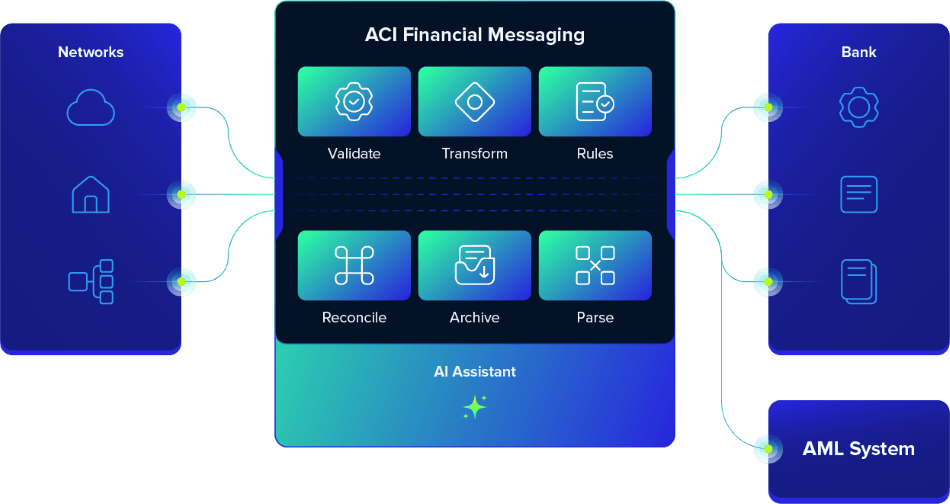
the Framework
Step 1: Understand what’s driving messaging complexity
Supporting multiple standards is only part of the challenge. Managing constant change is what makes it difficult.
Financial messaging has never been more complex. Banks must support SWIFT MT and MX, ISO 20022 variants, domestic payment rails, SEPA schemes, and real-time payments, all with different formats, rules, and operational requirements.
Today, banks face:
- Moving beyond ISO 20022 compliance to operationalization
- Growing demand for real-time payments
- Expanding compliance and security requirements
- API-driven modernization and new connectivity models
- Increased pressure to improve cross-border payments
Individually, these challenges are manageable. Together, they create a fragmented messaging environment that’s harder to govern, investigate, and scale.
Step 2: Map every standard you touch
You can’t manage what you can’t see. Start with a full inventory.
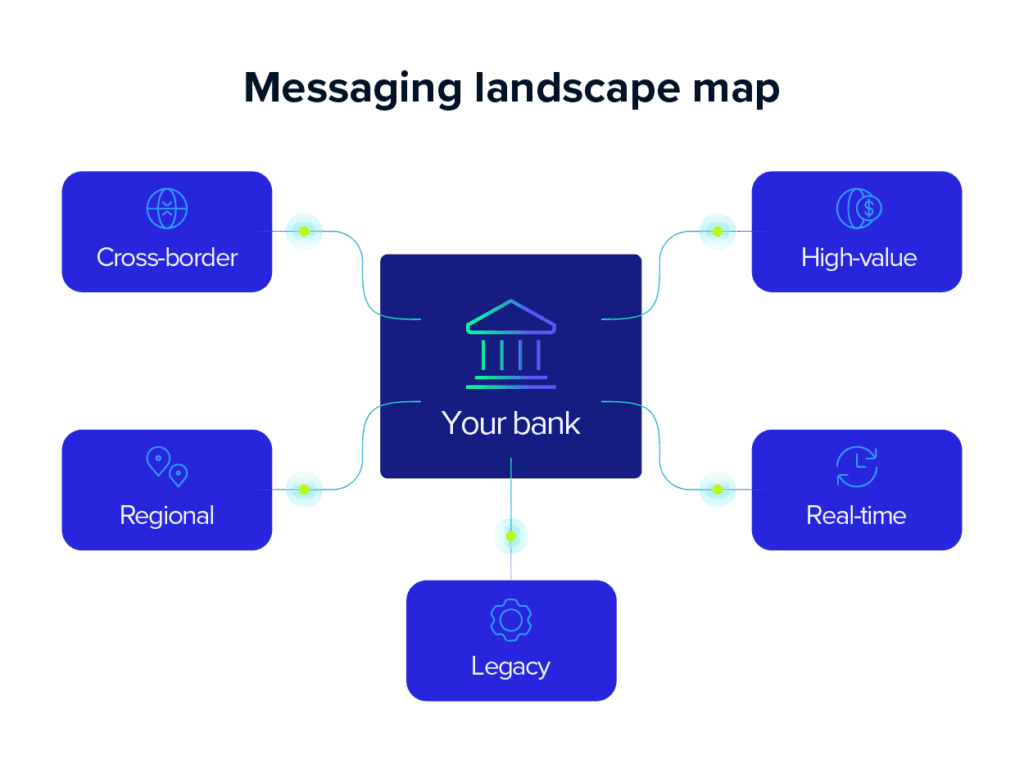
Most banks underestimate how many formats they actually manage. Document every standard across your payment flows. Core areas to map:
- Cross-border: SWIFT MT + MX (CBPR+)
- High-value domestic: RTGS and large-value clearing systems
- Regional schemes: SEPA SCT, SDD, SCT Inst
- Real-time: Domestic instant rails
- Legacy systems: Residual MT or proprietary formats
Expect to discover multiple ISO 20022 variants, parallel MT and MX flows, and scheme-specific processing rules.
Step 3: Enable native translation across standards
Translation should be embedded, not bolted on.
MT and MX coexistence or structured versus semi-structured data are among the biggest barriers to efficient message management. Banks often rely on weak external converters, creating data loss, mapping errors, and operational delays.
A modern approach requires:
- MT ↔ MX conversion
- ISO 20022 variant-to-variant transformation
- Data normalization for downstream systems
This allows you to maintain coexistence during long migration cycles, avoid forced system replacements, and save time by minimizing manual intervention.
Step 4: Centralize validation and compliance controls
Control must be centralized, even if processing is distributed.
Every payment scheme comes with its own validation rules, cutoff times, and regulatory requirements. These controls are distributed across systems and difficult to maintain. What does “good” look like? A centralized approach that enables:
- Pre- and post-processing validation
- Scheme-specific rule enforcement
- Security controls (e.g., authorization, audit logging)
The result is consistent compliance across all payment types, fewer exceptions, fewer failed or rejected transactions, and stronger operational control.
Step 5: Unify visibility across all messages
Visibility isn’t a reporting feature; it’s an operational requirement.
Today’s payment environments require visibility across every scheme and every message. When messages are spread across systems, finding and understanding them is hard; investigations become slower, exceptions take longer to resolve, and audit requests become more difficult to support. What you require is:
- A single view of all inbound and outbound messages
- Full lifecycle traceability (original, acknowledgment, return, reject)
- Search across message content, type, and status
This approach is critical for operations teams, especially when payments fail, exceptions occur, and regulators require detailed evidence.
Step 6: Design for coexistence, not big-bang replacement
Modernization doesn’t have to mean replacement.
A common misconception is that payments modernization requires a full system overhaul or forced cutover. It doesn’t.
Mid-sized banks need a solution that integrates with existing core systems, supports multiple integration methods (APIs, files, queues), and deploys without large-scale transformation. Look for an approach that:
- Coexists with legacy infrastructure
- Reduces dependency on complex integration projects
- Enables rapid deployment and faster time to value
- Supports phased modernization
Step 7: Bring it all together through an orchestration layer
Reduce complexity with a layer above your core, not more point solutions.
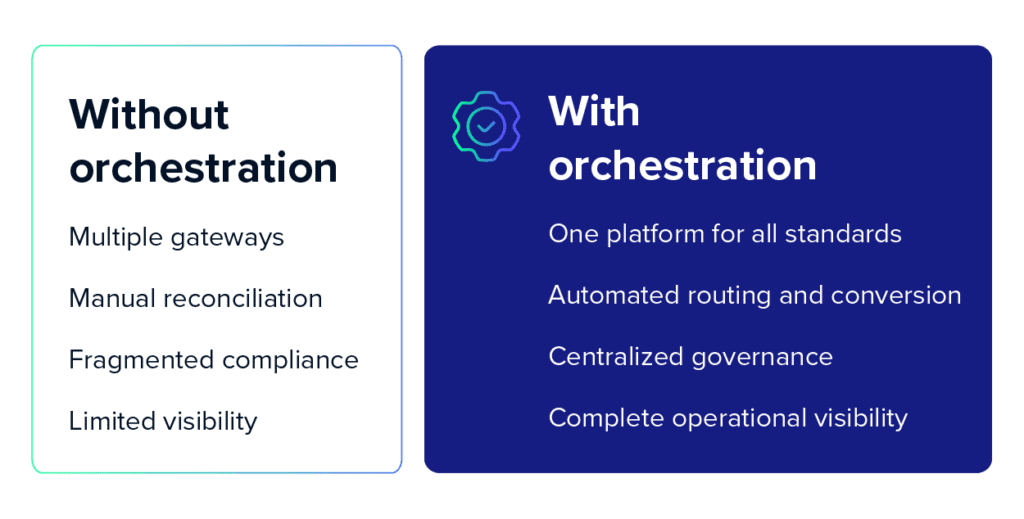
Every new scheme gateway or format converter adds fragmentation, not control. An orchestration layer instead sits above existing systems and helps banks:
- Route messages across schemes
- Convert formats and standards
- Centralize validation and controls
- Unify operational visibility
- Govern processing end to end
Rather than replacing your core infrastructure, it creates a consistent operating model across every payments rail and messaging standard.
How ACI Financial Messaging delivers
Simplify multi-standard payments messaging without replacing core systems
As payment standards, schemes, and regulatory requirements continue to evolve, banks need a more efficient way to manage messaging complexity. ACI Financial Messaging enables banks to:
- Convert seamlessly between formats and standards
- Govern processing with built-in compliance and end-to-end visibility
- Bring structure and control to complex payment ecosystems