
FASHION CONSUMER TRENDS REPORT
The new rules of fashion and sportswear payments
How shopping behavior, payment experiences, and trust shape conversion and loyalty in fashion retail

In this report
Introduction
Fashion payment trends are shifting faster than retailers can plan for, and today’s business climate has done fashion and sportswear retailers few favors. Economic uncertainty, shifting consumer expectations, and social media-driven trends are making purchasing patterns harder to predict, while lower disposable income, short product lifecycles, and high return rates are making customer loyalty harder to earn and easier to lose. As a result, retailers need a deeper understanding of changing shopper payments behavior and the experiences that influence conversion, loyalty, and profitability, from flexible fulfillment options to seamless payment journeys.
To better understand how consumers shop, pay, and engage with fashion and sportswear brands, ACI Worldwide commissioned research among 3,000 consumers across the US and UK. What the study explored:
- Purchase behavior and motivation
- Hybrid channel behavior
- Value of retail apps
- Payments friction and revenue impact
- Payment method preferences
- Return behavior
- Consumer readiness for AI-driven commerce
The findings point to what’s shaping today’s fashion shopper behavior, and where retailers, through payments and the wider shopping experience, can improve conversion, loyalty, and profitability.

Data deep dives
Impulse buying is making fashion demand more variable and less seasonal
Seasonal demand planning, already under pressure for years from fast fashion and drop culture, is complicated further by how varied and unpredictable impulse buying has become.
Our survey shows sales and promotional events top the list of fashion impulse-purchase triggers, followed closely by the urgent need to replace an existing item.
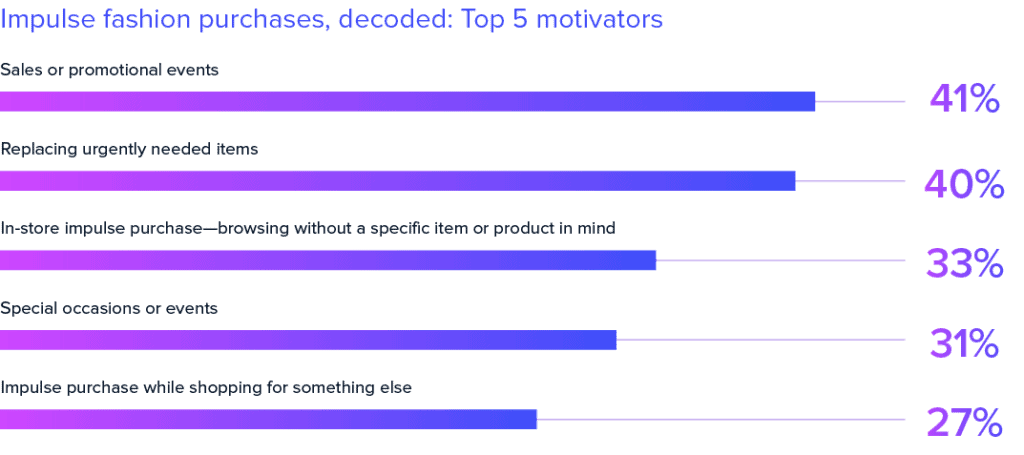
41%
Make an impulse purchase for sales or promotions
49%
Of sportswear shoppers buy on impulse
22%
Of 18–24s buy on impulse via social/influencer trends
Fashion shoppers move fluidly between channels—in-store, app, web
As omnichannel fashion shopping becomes the default retail experience, fashion shoppers are expecting more than just brand consistency across their buying journeys. Going above and beyond to meet increasing expectations has become the new competitive imperative.
Not surprisingly, our survey shows a supermajority of shoppers buys online for home delivery (68%). But what sticks out is the growing popularity of the hybrid experience. More than one-third of shoppers BOPIS, a behavior that also saves them the cost of shipping, while many mix online purchasing with in-store returns and fulfillment experiences.
Consumers are embracing hybrid journeys to get goods more quickly, for convenience, or to enhance the overall experience.
35%
Buy online, collect in-store
41%
Of women vs. 28% of men buy online, collect in-store
How omnichannel fashion shoppers mix channels
| Ways people shop for clothing, footwear, or fashion items | Overall | US | UK |
|---|---|---|---|
| Buy online for home delivery | 68% | 63% | 70% |
| Buy online, collect in-store | 35% | 21% | 41% |
| Buy online, return in-store | 28% | 26% | 29% |
| Buy in-store, return by post/courier | 20% | 21% | 20% |
| Place an order in-store for home delivery or store collection | 18% | 17% | 18% |
| Use retailer app in-store to order or purchase | 15% | 16% | 14% |
Retail apps drive a better fashion shopping experience
Fashion retailers can no longer assume customer loyalty. Well-designed retail apps can help earn it. Our survey shows what shoppers actually value in an app. Unlike payment preferences, app behavior is consistent across the US and UK. Here, the meaningful splits are gender and age.
Women are much more likely than men to use apps, and they value them most for easier browsing, order tracking, return management, and access to promotions and saved payment credentials. Sportswear shoppers go even further: 44% value apps for easier browsing, 42% for order tracking/returns, and 42% for exclusive discounts and promotions.
Within retail app adoption, the perceived benefit of personalization is low overall (11%), but it is nearly five times higher among 18- to 24-year-olds (19%) than among 55- to 65-year-olds (4%). This interest is likely to grow as younger generations gain more spending power. Sportswear shoppers also value personalization within apps: 17% find personalized recommendations useful.
34%
Use apps for a smoother shopping experience (44% for sportswear shoppers)
41%
Of women vs. 27% of men value an easier app-browsing and shopping experience
Retailer app adoption: Who values what
| The main benefits fashion apps provide shoppers | Overall | Women | Men |
|---|---|---|---|
| Easier browsing/shopping experience | 34% | 41% | 27% |
| Order tracking and returns | 33% | 39% | 27% |
| Exclusive discounts/promotions | 32% | 37% | 27% |
| Loyalty points or rewards | 30% | 35% | 24% |
| Faster checkout or saved payment details | 25% | 29% | 21% |
| Personalized product suggestions | 11% | 11% | 11% |
Payment method usage varies by market, channel, and age
Payment method preference isn’t one-size-fits-all, even between two very closely related markets. US shoppers rely more heavily on credit cards and cash in-store while UK shoppers gravitate toward debit cards and digital wallets.
This gap narrows online for some methods: buy now pay later (BNPL) and PayPal usage converge almost completely across both markets.
With nearly one in five shoppers abandoning their online carts for lack of a preferred payment method, closing that gap starts with knowing which methods matter most in each market.
BNPL adoption: Nearly one in five online shoppers
For retail payments, variation is everything. While US and UK shoppers mostly favor debit cards and digital wallets, nearly one in five shoppers uses BNPL for online purchases, particularly among Millennials and older Gen Z consumers.
68%
Prefer debit cards in-store, and 62% online
51%
Of 18–24s prefer digital wallets
35%
Pay cash in-store, and 8% use cash on delivery for online purchases
Payment methods used for fashion purchases in-store, and online
| In-store | Online | |||||
|---|---|---|---|---|---|---|
| Payment method | All | US | UK | All | US | UK |
| Debit card | 68% | 61% | 71% | 62% | 54% | 67% |
| Credit card | 38% | 48% | 33% | 46% | 54% | 42% |
| Digital wallet | 30% | 23% | 34% | 36% | 29% | 39% |
| PayPal | 7% | 10% | 5% | 35% | 35% | 34% |
| BNPL | 5% | 8% | 4% | 19% | 19% | 19% |
| Cash/cash on delivery | 35% | 47% | 30% | 8% | 13% | 4% |
Checkout friction and payment failures cost fashion retailers revenue
Fashion and sportswear retailers are fighting an uphill battle against rising costs and shrinking margins, with many of those pressures outside their control. Yet checkout friction is one of the most addressable causes of lost revenue in their hands, and reducing cart abandonment remains one of the most effective revenue recovery levers, often hiding in plain sight.
Payment failures, missing preferred payment methods, surprise charges at checkout, and other points of friction continue to undermine conversion and create avoidable revenue leakage.
53% of shoppers will try another payment method when a transaction fails, but 39% abandon the purchase altogether, and 22% switch to a competitor. Unexpected costs at checkout are even more damaging, causing 40% of shoppers to walk away.

39%
Will give up on the purchase if the payment fails
40%
Abandon the purchase if a surprise charge is added at checkout
19%
Abandon the purchase if their preferred payment method is not available
Causes of checkout friction and cart abandonment
| Cause | Overall | US | UK |
|---|---|---|---|
| Surprise cost added at checkout | 40% | 37% | 42% |
| Website or app was not working properly | 26% | 24% | 28% |
| Checkout was too long or complicated | 22% | 20% | 23% |
| Preferred payment method was not available | 19% | 18% | 19% |
| Didn’t trust the checkout process | 17% | 17% | 17% |
| Payment failed or was declined | 16% | 18% | 16% |
| Authentication/security steps failed or too inconvenient | 15% | 15% | 16% |
Response to payments failure
| Response | Overall | US | UK |
|---|---|---|---|
| Try a different payment method | 53% | 61% | 48% |
| Try again using the same payment method | 47% | 43% | 49% |
| Try to complete the purchase later | 42% | 35% | 46% |
| Give up on the purchase altogether | 39% | 40% | 38% |
| Purchase from another retailer | 22% | 22% | 23% |
Fashion and sportswear retailers face a returns dilemma
Fraud and returns are often discussed together, but they’re not the same problem. Many returns happen because shoppers don’t have enough information to make confident purchase decisions. In fact, 79% agree that better sizing guidance, product information, or reviews would help prevent returns.
Another challenge is return bracketing, where shoppers intentionally buy more items than they expect to keep. Liberal return policies can encourage this behavior, with 66% admitting that free and easy returns make them more likely to order multiple items and send some back. Rather than treating every return the same way, retailers can use account-level analytics to identify patterns of repeat bracketing and address the behavior more precisely.
Whether it’s returning worn items or substituting products to obtain a refund, fraud is deliberate and requires its own response. According to our survey, 37% of shoppers believe returns abuse and fraudulent returns are more common today than they were a few years ago. Retailers need sophisticated, data-driven detection capabilities that can reduce risk without creating friction for legitimate customers.
The challenge for fashion retailers is addressing unnecessary returns, bracketing, and fraud without undermining customer loyalty. With 55% of shoppers saying they would buy elsewhere if return policies became more restrictive, tightening them for every shopper is unlikely to be the answer. Instead, retailers need a more targeted approach that treats each issue on its own terms.
79%
Agree that better sizing, product information, or reviews would reduce returns
37%
Believe misuse of returns and refunds is more common today
55%
Say stricter return policies would make them shop elsewhere
Shopper attitudes about returns
| Statement related to returns and shopping behavior | Agree | Disagree |
|---|---|---|
| Better sizing, product information, and reviews would reduce unnecessary returns | 79% | 4% |
| Liberal return policies encourage bracketing, or buying more items than intended to keep | 66% | 8% |
| Stricter return policies would make me shop elsewhere | 55% | 14% |
| Stricter return policies would make me shop more carefully | 52% | 15% |
| Inappropriate returns are more common now than in past years | 37% | 11% |
Shoppers want AI to save them money, not shop on their behalf
AI is becoming a bigger part of the retail experience, but shoppers are drawing clear boundaries around where they see value. While there is interest in AI-powered shopping tools, consumers are far more comfortable with AI helping them make decisions than making decisions on their behalf.
Our research shows that adoption starts with practical, low-risk use cases. Shoppers are most interested in features that help them save money, compare options, and discover products more efficiently. More autonomous agentic commerce experiences, such as AI making purchases on a shopper’s behalf, still face resistance: 53% remain unwilling to let AI purchase on their behalf under any circumstances.
Only 7% of respondents would allow an AI assistant to make purchases without approval (5% within set limits and 2% for specific retailers only), while most consumers prefer to maintain oversight of spending decisions.

35%
See value in AI-driven price-drop alerts and price comparisons
27%
Want help finding similar products
18%
Find personalized recommendations useful, rising to 25% among 18- to 24-year-olds
Comfort with AI shopping assistant purchases
| What an AI shopping assistant is allowed to do | Overall |
|---|---|
| Recommend only | 20% |
| Approve every purchase | 14% |
| Allow AI purchases within limits (set budget) | 5% |
| Make AI purchases for specific retailers | 2% |
| Not comfortable with AI purchasing under any circumstances | 53% |
The pattern is clear: Consumers are willing to engage with AI when it improves convenience, relevance, or value, but they still want to remain in control of the shopping journey.
Useful AI shopping features: Gender differences
Useful AI shopping features: Generational divide
THE GENERATION AI GAP
Younger shoppers (18- to 24-year-olds) are more than twice as likely to value AI-driven personalization as 55- to 65-year-olds (25% vs. 11%), while older shoppers place greater value on features that help them save money (34% of 55- to 65-year-olds vs. 27% of 18- to 24-year-olds).

What this all means for fashion and sportswear retailers
Fashion shopping trends uncovered in this research point to one direction: Demand in fashion and sportswear is strongly driven by promotions, urgency, and social media moments. Shoppers move more fluidly across channels and devices rather than following one path to purchase. And loyalty isn’t something retailers can bank on; it has to be earned, transaction by transaction, through an experience that doesn’t get in the way.
One pattern surfaced in nearly every chapter: The shoppers retailers most need to win are also the ones least tolerant of friction. Women lead hybrid shopping and app adoption but abandon purchases more often and give up entirely more often when something goes wrong.
Younger shoppers shop most frequently and are the most open to new payment methods and AI-assisted discovery, but they’re also quick to walk when a policy or a checkout experience doesn’t meet them where they are. Retailers optimizing for the average shopper are, in effect, under-serving their best customers.
Geography complicates this further: The US and UK are close enough to tempt a single playbook and different enough to punish one. Payment method mix, response to payment failure, and even attitudes toward returns diverge between the two markets, proof that “international” doesn’t mean “uniform,” even in such closely related markets.
Sportswear shoppers are a category apart and worth watching closely. They place greater value on app features most closely linked to loyalty, and they are especially receptive to personalized recommendations. The same pattern holds for AI-assisted shopping: Sportswear buyers reject AI features at a lower rate and are notably more receptive across the board, from price-drop alerts to personalized suggestions.
For retailers, that translates into a few concrete priorities:
Build for demand volatility in both operations and payments infrastructure
Fix checkout friction and payments failure: The most direct and accessible revenue-recovery lever
Localize payments mix by market and channel, rather than defaulting to a single global standard
Support the full range of hybrid shopping behaviors and recognize the customer across touchpoints
Treat the app and payments experience as loyalty tools, not just transaction tools
Address returns as two separate problems: Better product information for genuine returns, smarter data for abuse
Introduce AI-assisted features where demand is already highest: Price comparisons and discovery, a clear entry point into agentic commerce
Fashion consumers are at the forefront of many shopping experience innovations. Payments emerge as the clearest thread connecting conversion, loyalty, and customer experience. Unlike many retail challenges, checkout friction, payment failures, and payment choice are areas retailers can directly influence. In a market defined by unpredictability, payments performance increasingly separates revenue captured from revenue lost. The brands that remove friction at critical moments, scale seamlessly with spikes in demand, and create experiences customers actively value will be best positioned to convert demand, retain customers, and grow profitably. Retailers that treat payments as a profit engine rather than a back-end function will be better equipped to turn uncertainty into competitive advantage.
About the survey
Methodology
Ready to turn payments friction into revenue?
The findings in this report point to a clear opportunity: Checkout friction, payment failures, and declines are among the most addressable levers fashion and sportswear retailers have to protect margin and grow revenue. The ACI Payments Optimization Program helps merchants act on exactly this, using AI-driven analytics and expert knowledge to pinpoint the root causes of declines and implement targeted improvements that increase acceptance rates, lower costs, and deliver a smoother checkout experience.