
Omnichannel payments REPORT
Connected payments: One customer, every channel
How unifying customer, payments, and loyalty data across every channel lifts conversion, strengthens retention, and recovers lost revenue.

In this report
Introduction
A customer browses on their phone, buys online, picks up in-store, and returns the item somewhere else entirely. Every step is expected to feel like one conversation, not four separate transactions. Retailers have built systems that handle each of those steps well individually, but connecting them into something that feels continuous is where most still fall short.
That gap creates real friction: personalization that falls flat, innovation that moves slower than it should, revenue lost between systems that don’t talk to each other. Competitive advantage now depends on everything that happens around the payment itself, whether a retailer can identify a customer before checkout, recognize them across every channel, preserve context after the purchase completes, and get an online order into a customer’s hands, in-store, in under an hour. Connected payments are what make that kind of consistency possible.
At the same time, advances in AI and agentic commerce are raising the stakes. As AI takes on more of the shopping journey, from recommending products to completing purchases on a customer’s behalf, retailers need payment systems that are secure and adaptable enough to support new experiences, faster innovation, and increasingly personalized customer journeys.
To better understand how retailers are navigating this transition, ACI Worldwide and Retail Dive’s Studio surveyed 102 payment operations leaders at retail organizations ranging from $250M to more than $5B in annual revenue across the US and UK during June 2026. The findings reveal an industry that has made remarkable progress modernizing payment capabilities, alongside a new challenge: Retailers are no longer investing just to process payments faster or support more methods. They’re investing to build customer experiences that strengthen loyalty, sharpen personalization, and recover revenue that fragmented systems leave behind.
Based on the survey findings and expert insights, this report explores:
- How blended commerce is reshaping customer expectations
- Why payments modernization has become a customer experience imperative
- The hidden costs of disconnected payments, customer, and loyalty data
- Why a unified, adaptable payments infrastructure is critical for future innovation
- How customer recognition drives loyalty, growth, and revenue uplift

Key findings
Rising to meet higher customer expectations
Retail leaders no longer question whether commerce has changed; that debate is over. What’s new is the baseline it has created: Customers expect retailers to recognize them across channels, and they want every interaction to feel consistent and familiar.
The survey suggests retailers understand that reality. What they’re less confident about is their ability to deliver that heightened experience day after day, for shopper after shopper.
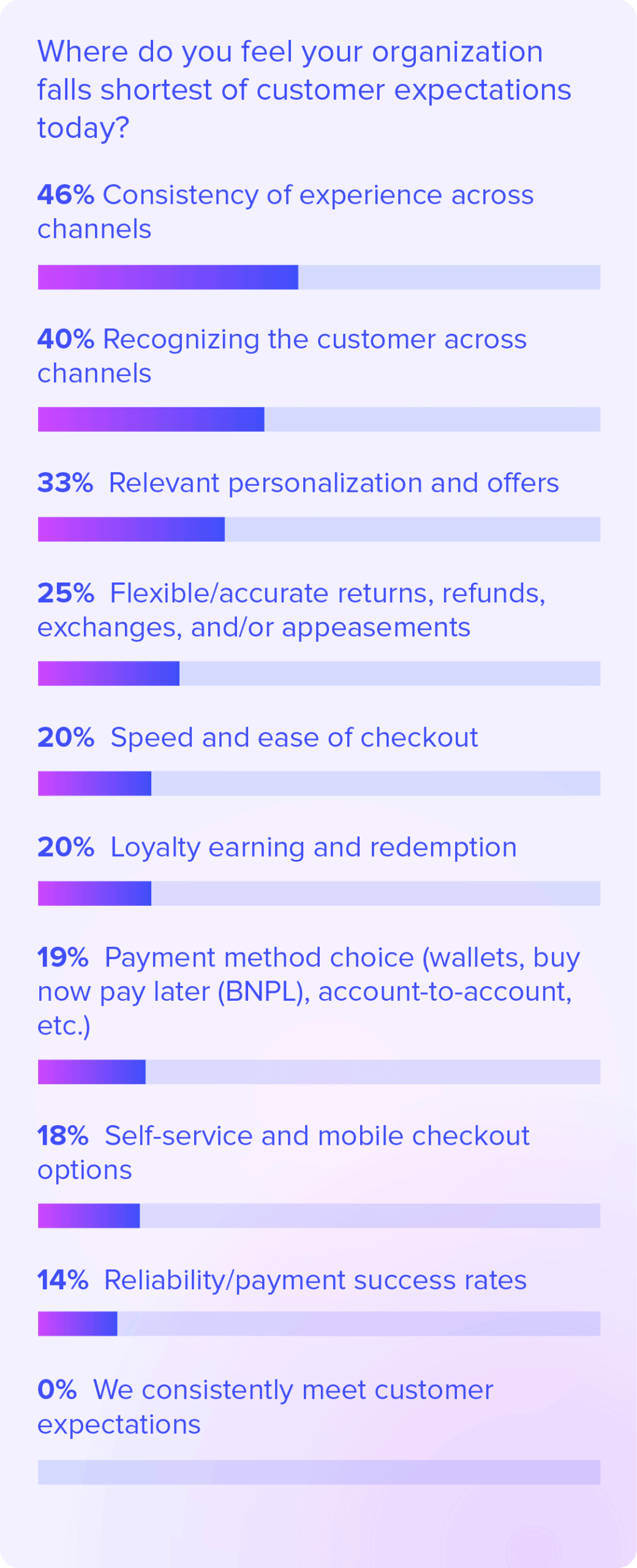
Across every blended commerce behavior measured, from cross-channel shopping to digital wallets, respondents reported significant growth. Yet when asked whether their organizations “consistently” meet customer expectations, not a single respondent said yes. That gap points to a clear priority for retailers investing in omnichannel payments: closing the distance between what customers expect and what operations can actually deliver, day in and day out.
88%
recognized increased cross-channel shopping
87%
saw greater use of digital wallets and new payment methods
55%
said customers held higher expectations for seamless experiences
The hardest place to recognize the customer is in the physical store.”
Dan Coates
Product Management Director
ACI Worldwide
Retailers’ greatest challenge in meeting customer expectations isn’t adding new channels. It’s making the ones they already have work together.
Take a customer who begins shopping online, completes a purchase in-store at one location, and later returns the item at a different location entirely. Customers love this kind of flexibility; it makes life easier and expands what their shopping experience can be. Retailers, however, acknowledge that maintaining context across those interactions, the core promise of payments orchestration, remains genuinely difficult.
“The bar gets higher every year. Multichannel is doable. Omnichannel is extremely difficult. Blended commerce fills the gap, but can be especially challenging to get right,” says Balaji Parthasarathy, Senior Director, Product, Merchant Omnichannel at ACI Worldwide, a global payments technology company that helps merchants orchestrate and optimize omnichannel payments.
Complexity multiplies as retailers add sales and marketing channels, payment methods, fulfillment options, and return policies. The real work is pulling all of it into one connected customer journey, and the hardest part often isn’t digital at all.
“Whether it’s an email or phone number, a mobile app or a credit card, every one of those methods still depends on the retailer’s systems being connected behind the scenes,” says Dan Coates, Product Management Director at ACI Worldwide. “If the payments, loyalty, and identity data aren’t linked, the customer isn’t really being recognized. The hardest place to recognize the customer is in the physical store.”
Payments infrastructure hasn’t kept pace
For years, payments modernization meant one thing: making transactions faster, more secure, more reliable. Retailers have largely nailed that. It’s no longer what separates the leaders from everyone else.
Today’s customers don’t care how fast a transaction clears. They care whether the retailer remembers them five minutes later, in a different app or at a different register.
That’s a much harder bar, and it’s forcing payments infrastructure to do jobs it was never originally built for: recognizing customers across channels, linking loyalty activity, powering personalization, holding onto context as a shopper moves from phone to store to return counter. Get that right, and a retailer also gets better routing, sharper fraud detection, and more conversions, almost as a side effect.
98%
still name a blended commerce gap
69%
call their payment systems capable or highly optimized
Most retailers agree with him in principle. Far fewer act on it. A separate ACI survey of 200 merchants in the US and Europe in early 2026 found that 70% think payments optimization is important, but only 25% treat it as a board-level priority. The gap is usually budget, not belief.
The most recent survey adds a strange wrinkle to that picture. Nearly seven in 10 retailers describe their payment systems as capable or highly optimized. Almost every single one of them, in the same breath, admits to a real gap in supporting blended commerce. Read quickly, that looks like a contradiction. It isn’t. Retailers aren’t saying their systems are broken. They’re saying their systems work fine in isolation and fall apart the moment a customer crosses from one channel to the next, and when cost, convenience, channel, or urgency don’t line up with what a customer expects, that customer simply buys somewhere else.
| What gaps exist within your organization when it comes to supporting blended commerce? | |
|---|---|
| Lack of unified customer/payments data | 57% |
| Inconsistent payments experience across channels | 48% |
| Fragmented loyalty or identity systems | 40% |
| Operational complexity | 27% |
| Limited payment method availability | 25% |
| Difficulty building a business case | 21% |
| No gaps exist in our organization when it comes to supporting blended commerce | 2% |
Coates believes the survey reveals an industry that has made progress, just not enough of it. “It’s an indicator that retailers are treading water,” he says. “Many retailers are still treating payments as a utility rather than as an optimization tool to improve things.”
That distinction matters. Retailers have largely solved the transaction itself.
Payments are a way to increase revenue. They are not merely a utility that is nearly the end of a transaction.”
Balaji Parthasarathy
Senior Director, Product, Merchant Omnichannel
ACI Worldwide
The harder problem, the one still unsolved, is everything surrounding it: fragmented customer, payments, and loyalty data that retailers are left interpreting on their own, channel by channel, while struggling just to keep the experience consistent. Those barriers are what stand between retailers and the kind of deeply connected customer experience they’re aiming for. For Coates, these gaps highlight a clear operational need.
“Retailers desperately need a framework to stitch those journeys together,” he says.
The hidden revenue leak of disconnected data
Most modern payment systems are built to complete the transaction, and payments orchestration platforms can optimize that part well. The bigger risk is what those systems miss around the edges: a purchase that doesn’t get recognized through loyalty, a return that turns unnecessarily complicated, a customer forced to repeat information because one system can’t see what another already knows.
Individually, these moments feel small, but together they add up to a steady drain of missed opportunities. They shape how customers see a brand, and whether they come back to buy again. The survey suggests retailers understand that these friction points carry real business consequences.
28%
can easily investigate and resolve payment issues through a connected view
40%
expect better CX and lifetime value from unified data
Asked where a more unified view of customer, payments, and loyalty data would create the greatest impact, respondents overwhelmingly pointed to customer-facing outcomes rather than operational efficiencies. Increasingly, retailers are starting to see connected payments as a way to make money, not just save it.
Which of the following areas would improve most if your organization had a more unified view of customer, payments, and loyalty data across channels?

What’s striking isn’t just where retailers expect improvement, but where they don’t. Operating costs and fraud management rank near the bottom of the list. Instead, respondents mostly associate connected data with stronger customer relationships, better personalization, and greater long-term value.
One key example: Only 28% of respondents say their organizations can easily investigate and resolve customer payment issues through a connected view. For everyone else, resolving even a routine customer issue means navigating multiple systems or manually piecing together information across channels.
Parthasarathy believes that’s because many retailers are still focused on improving today’s processes rather than rethinking them.
That’s the hidden cost of disconnected customer experiences. It’s not the flashing red light of a failed transaction. It’s the slow decline in sales from customers who never complete a second purchase, never deepen their loyalty connection, or never become long-term advocates because each interaction feels like a first date.
They move on, and the relationship ends before it ever has a chance.
The primary theme is, ‘Do I understand, recognize, and know my customer? How am I supporting them and how am I earning their loyalty?’ Retailers are just trying to make existing experiences work.”
Balaji Parthasarathy
Senior Director, Product, Merchant Omnichannel
ACI Worldwide
Cross-channel recognition is the new competitive advantage
Identifying a customer is only the starting point. The real value comes from what retailers do with that recognition:
- Can they remember a preferred payment method?
- Honor a loyalty benefit?
- Personalize an offer?
- Resolve a return more efficiently?
- Continue a conversation that began in another channel?
Those capabilities turn recognition from a technical achievement into a genuinely better customer experience. Recognizing the same customer across channels isn’t only a service improvement; it’s where retailers stop losing revenue to fragmented, duplicated, or missed transactions. It’s the difference between an email that says “It looks like you left something in your cart” and one that gets specific: “A cream colored version of the shoes in your cart would go great with the dress you purchased last week at our downtown location.”
34%
recognize the same customers consistently
8 in 10+
can recognize customers at least some of the time
40%
name recognizing the customer as where they fall shortest
Retailers are making progress, according to the survey findings. More than eight in 10 organizations report that they can recognize customers across channels at least some of the time, but only about one-third say they do so consistently.
That gap goes beyond a technology problem: It’s a missed opportunity to make every interaction more relevant, more personal, and more connected, which is exactly what omnichannel payments and unified customer recognition are built to close.
Coates described customer recognition as extending well beyond a single customer ID. Whether a retailer is identifying someone by their phone number, email address, tokenized credit card, or payment account reference (PAR), those are all aliases that should lead back to the same person.
Many retailers have turned to payments data to create another way of recognizing the same customer. PAR is one option: It gives merchants a common view of the underlying payment account number (PAN) or card number across token and card transactions, adding a customer identifier that works across every channel.
Being able to accurately identify that customer within any channel to honor them, recognize their preferences, likes, dislikes, and preferred payment type—that drive toward customization and personalization is really critical.”
Dan Coates
Product Management Director
ACI Worldwide
More than anything, retailers are investing because customer expectations demand it. Payments modernization has become the infrastructure that lets organizations introduce new experiences, support new channels, and adapt without rebuilding the entire customer journey every time commerce changes.
Why AI raises the stakes
The same connected infrastructure that closes the gaps in today’s customer journeys will also decide how well retailers can put AI to work. Retailers aren’t looking to AI mainly to cut costs. They want it to make customer experiences better: stronger authorization and payment success rates, faster rollout of new experiences, sharper personalization, and more value per customer.
But AI can’t invent context that doesn’t exist. If a retailer’s payments, loyalty, and customer data are scattered across separate systems, no algorithm can stitch them back together after the fact. The retailers who get the most out of AI won’t be the ones with the most advanced models. They’ll be the ones who connected their data first.
“If you’re going to optimize AI as you operationalize it, your payment systems need to be connected. AI is only as smart as the data you feed it. If your payments, loyalty, and customer data are still living in separate systems, AI won’t really fix that. Connecting those systems is the prerequisite, not an afterthought,” Parthasarathy explains.
The survey points to exactly where that work needs to start if retailers want their systems ready for AI, and ready to improve the customer journey overall.
48%
expect AI to have the greatest impact on success rates
40%
expect the greatest impact on speed to launch new experiences
0%
expect no meaningful improvement from AI

AI is only as smart as the data you feed it. If your payments, loyalty, and customer data are still living in separate systems, AI won’t really fix that. Connecting those systems is the prerequisite, not an afterthought.”
Balaji Parthasarathy
Senior Director, Product, Merchant Omnichannel
ACI Worldwide
In which of the following areas do you anticipate AI having the greatest impact on your organization’s payments and customer experience strategy over the next 12-24 months?
Getting the basics right makes the difference
When asked which customer purchase and payment experiences matter most today, respondents didn’t reach for the flashiest answers. Scan-and-go, kiosks, and app-assisted shopping all landed near the bottom of the list. What topped it instead was something far less glamorous: Nearly three-quarters of retailers prioritized stored payment credentials that work across web, app, and store, and 56% pointed to cross-channel refunds, exchanges, and appeasements.
None of these will make headlines the way a new checkout experience might. But they’re the plumbing that makes every other experience actually feel connected, and without them in place, nothing built on top holds up for long.
Which of the following customer purchase and payment experiences are most important to your organization today?
Building a foundation for what’s next
The survey tells the story of an industry in transition. Retailers have already invested heavily in digital commerce. They’ve expanded payment options, new channels, and modernized ways to shop. What’s left isn’t a question of adding more. It’s a question of connecting what’s already there.
That need only grows as retailers adopt AI more broadly. The survey found almost no skepticism that AI will shape payments and customer experience strategy going forward. The real question is whether organizations have built the connected payments and customer infrastructure to actually take advantage of it once it arrives.
Beyond today’s multi-channel experiences, connected payments infrastructure may end up deciding who’s positioned to win in agentic commerce. AI is moving well past making recommendations, toward assembling carts, choosing payment methods, redeeming loyalty benefits, and completing purchases on a consumer’s behalf. As that shift happens, the ability to securely recognize customers, access unified transaction context, and orchestrate payments across channels becomes a real competitive advantage, not a nice-to-have. The infrastructure retailers build today may ultimately decide how well they compete in whatever comes next.
AI will help customers analyze the
most convenient, best price including delivery, or fastest way to get what they want. It will enhance the in-store environment as well as online. Retailers who can’t do this will miss out on business.”
Dan Coates
Product Management Director
ACI Worldwide
Throughout the survey, retailers consistently pointed to the same priorities, which are the building blocks of modern commerce:

Recognizing customers across channels.

Preserving context throughout the shopping journey.

Delivering seamless experiences regardless of where they begin or end.
The findings also suggest that retailers understand this work is never finished.
Customer expectations keep rising, shopping habits keep shifting, new payment methods keep emerging, and business models keep changing alongside all of it. Organizations that build flexible, connected payment infrastructures will be able to adapt to each shift without having to rebuild the customer experience from scratch every time.
“Payments can never be ‘set it and forget it,’” Parthasarathy says. The organizations that thrive won’t stop at modernizing payments. They’ll keep modernizing the customer experience, and profit from doing it, understanding that the future of blended commerce won’t come down to how many channels a retailer supports. It will come down to how effortlessly customers move between them, and how much revenue retailers capture along the way.
That’s where ACI Worldwide comes in. As the independent payments platform that delivers intelligence across ecosystems, ACI helps retailers connect the moments that matter most: recognizing customers, recovering lost revenue, and orchestrating across channels to drive higher returns, better outcomes, and simplified scalability.
Turn every eCommerce click into a connected customer
The findings in this report point to a clear opportunity: Customers who browse on mobile, buy online, and return in-store expect one seamless experience, and most retailers still lose revenue in the gaps between channels. The ACI Payments Orchestration Platform helps omni-commerce merchants close those gaps by unifying their payments so they can recognize customers across channels to improve the customer experience, lifetime value, and authorization rates.